
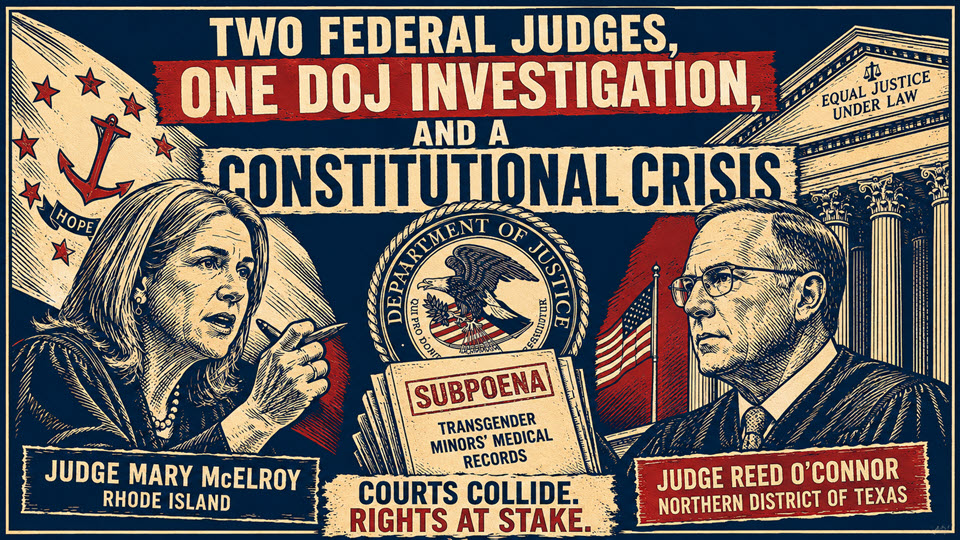
Two Federal Judges, One DOJ Investigation, and a Constitutional Crisis
Two Federal Judges, One DOJ Investigation, and a Constitutional Crisis
Highlights
- Federal judges issued conflicting rulings over transgender minors’ medical records.
- DOJ accused of misleading courts and engaging in forum shopping.
- Rhode Island judge condemned government lawyers’ “lack of candor.”
- Texas court ordered hospitals to surrender records despite subpoena disputes.
- Case raises major constitutional and judicial independence concerns.
The Justice Department’s Expanding Campaign Against Gender-Affirming Care
A legal battle over transgender healthcare records has evolved into one of the most extraordinary judicial confrontations of the modern era, exposing deep fractures within the federal court system and raising profound questions about executive power, judicial ethics, venue manipulation, and constitutional privacy rights.
At the center of the dispute is the Trump administration’s escalating campaign against gender-affirming care for minors. What began as an administrative investigation into hospitals and physicians rapidly transformed into a nationwide legal struggle involving accusations that Department of Justice attorneys misled federal courts, manipulated procedural rules, and sought out ideologically favorable judges to advance politically charged investigations.
The controversy intensified after federal courts outside Texas repeatedly rejected DOJ attempts to obtain broad medical records from hospitals providing care to transgender adolescents. In response, the Department shifted strategy, filing enforcement actions in the Northern District of Texas — a jurisdiction known for its conservative judiciary and for attracting politically significant litigation.
The resulting clash between Judge Reed O’Connor in Texas and Judge Mary McElroy in Rhode Island has become emblematic of a broader institutional crisis unfolding inside the federal judiciary itself.
Trump’s Executive Order and the Federal Strategy Shift
The conflict traces back to President Donald Trump’s early executive actions after returning to office. Within his first week, Trump signed an executive order directing federal agencies to scrutinize and potentially curtail gender-affirming healthcare for minors.
The order characterized puberty blockers, hormone therapy, and certain surgeries as forms of “chemical and surgical mutilation” when used to treat gender dysphoria. The administration argued that healthcare providers were misleading patients and insurers regarding the long-term effects of treatment.
Attorney General Pam Bondi later amplified the administration’s position through a memorandum directing DOJ divisions to investigate hospitals and physicians providing gender-affirming care. The directive instructed federal attorneys to examine whether providers violated the Food, Drug, and Cosmetic Act (FDCA), particularly through alleged misuse of billing codes and so-called “off-label” prescribing practices.
That legal theory immediately drew criticism from constitutional scholars and healthcare law experts.
Off-label prescribing — the practice of prescribing FDA-approved drugs for uses not explicitly listed on their labels — is both common and legal throughout American medicine. Courts have consistently recognized physicians’ discretion to prescribe approved medications according to professional judgment and patient needs.
Indeed, federal law itself explicitly preserves physicians’ authority to prescribe medications off label within legitimate doctor-patient relationships.
Critics noted the inconsistency in the administration’s position. Previous Republican administrations, including Trump’s own first administration, had defended off-label prescribing in unrelated contexts. Legal observers argued that the DOJ appeared to be applying a novel interpretation of the FDCA selectively and almost exclusively against providers treating transgender youth.
Administrative Subpoenas and Escalating Resistance
The DOJ’s Enforcement and Affirmative Litigation Branch subsequently issued numerous administrative subpoenas to hospitals nationwide seeking extensive patient records related to transgender minors.
The requests reportedly demanded years of records, including diagnoses, treatment regimens, patient identities, and physician documentation.
Hospitals and advocacy groups quickly challenged those subpoenas in court.
Outside Texas, federal judges frequently rejected or narrowed the government’s demands. Courts expressed skepticism about whether the DOJ possessed a valid statutory basis for investigating physicians over standard off-label prescribing practices.
According to court filings, many hospitals had also been actively negotiating with DOJ attorneys regarding subpoena scope and privacy protections.
One of those hospitals was Rhode Island Hospital.
The Texas Filing That Changed Everything
On April 30, 2026, the Department of Justice filed a petition in the Northern District of Texas seeking enforcement of an administrative subpoena against Rhode Island Hospital.
The filing immediately raised eyebrows within the legal community.
Rhode Island Hospital is located approximately 1,700 miles from Fort Worth, Texas. The subpoena had reportedly been issued from Washington, D.C., by DOJ attorneys working there. None of the underlying events appeared connected to Texas.
Venue rules ordinarily require cases to be litigated in jurisdictions with meaningful factual or legal connections to the dispute. Those rules are designed to prevent “forum shopping,” where litigants seek favorable judges rather than appropriate venues.
Yet the DOJ filed the matter in Fort Worth, a division with only two active judges: Reed O’Connor and Mark Pittman, both conservative jurists with national reputations for hearing politically charged cases.
Judge O’Connor swiftly granted the DOJ’s requested enforcement order before Rhode Island Hospital could respond.
The hospital later argued that the government had omitted crucial information from its filing, including the fact that the parties had remained in active negotiations for months regarding the subpoena’s scope and timing.
According to the hospital’s filings, DOJ attorneys had previously indicated flexibility regarding production deadlines and had not suggested the hospital was refusing compliance altogether.
The government’s filing allegedly portrayed the hospital as having ignored the subpoena entirely.
That representation became central to the growing controversy.
Judge Mary McElroy’s Intervention
The dispute escalated dramatically when Rhode Island’s Child Advocate — a state official responsible for protecting children’s rights — filed an emergency action in federal court seeking to quash the subpoena altogether.
Judge Mary McElroy, presiding in Rhode Island, scrutinized the government’s conduct far more aggressively than the Texas court had.
During hearings, DOJ attorneys struggled to answer basic factual questions regarding the investigation’s timeline, the negotiations with Rhode Island Hospital, and the government’s rationale for pursuing enforcement in Texas.
McElroy reportedly pressed DOJ counsel repeatedly on inconsistencies between prior communications and sworn representations made to the Texas court.
The judge specifically questioned statements suggesting Rhode Island Hospital had ceased communicating with federal investigators months earlier, despite email exchanges occurring shortly before the Texas filing.
She also questioned whether the government had mischaracterized the hospital as a criminal target after DOJ attorneys previously indicated otherwise.
Perhaps most significantly, McElroy openly accused the DOJ of selecting Texas strategically because officials believed Judge O’Connor would be more favorable to the administration’s position.
The courtroom exchange became a defining moment in the litigation.
“You chose Justice O’Connor in Texas,” McElroy reportedly stated. “Just be honest enough to admit that.”
A Rare Judicial Rebuke
On May 13, Judge McElroy issued a blistering opinion quashing the subpoena.
Her ruling rested on three independent conclusions:
- The DOJ lacked a congressionally authorized basis for the investigation because off-label prescribing itself is lawful.
- The subpoena appeared motivated by political objectives rather than legitimate criminal investigation.
- Compliance would violate constitutional privacy protections for the affected children.
The opinion contained unusually harsh criticism of DOJ attorneys and their litigation tactics.
McElroy accused the government of withholding information, misleading courts, and engaging in blatant forum shopping. She specifically criticized what she described as “bad faith” litigation conduct and questioned whether DOJ officials had deviated from expected professional standards.
Such language is extraordinarily rare in federal judicial opinions directed at Department of Justice attorneys.
Federal judges generally extend significant deference to DOJ representations under the longstanding “presumption of regularity” — the assumption that government attorneys act honestly and in good faith.
McElroy’s ruling suggested that presumption had collapsed entirely in this case.
Judge O’Connor’s Countermove
The legal conflict might ordinarily have ended there.
Instead, it intensified.
Judge Reed O’Connor responded by issuing orders effectively preserving enforcement of the subpoena despite McElroy’s decision quashing it.
He directed Rhode Island Hospital to produce records directly to his court for safekeeping pending appellate review.
More controversially, O’Connor reportedly prohibited the hospital from seeking relief in other courts or cooperating with others pursuing related litigation.
Legal scholars immediately questioned the constitutional basis for such restrictions.
Critics argued the order potentially infringed First Amendment rights, including freedom of association and the right to petition courts for redress of grievances.
Others described the move as an unprecedented assertion of judicial authority extending beyond traditional procedural limits.
The hospital ultimately complied under protest, reportedly fearing sanctions or contempt proceedings against its attorneys if it refused.
The Broader Institutional Danger
What makes this dispute uniquely alarming is not merely the underlying political conflict over transgender healthcare.
Rather, it is the increasingly open conflict between federal courts themselves.
Federal judges traditionally exercise extreme caution to avoid directly undermining one another’s authority. The judiciary’s legitimacy depends heavily on mutual institutional respect and procedural consistency.
This case shattered many of those norms.
One federal court quashed a subpoena while another insisted on preserving enforcement authority over the same records. Judges issued competing directives. Litigants faced contradictory obligations and threats of sanctions.
Legal analysts warn that such clashes risk eroding public confidence in the judiciary as a coherent institution governed by shared procedural rules rather than partisan alignment.
The dispute also highlights how venue selection has become central to modern political litigation.
For years, litigants across the ideological spectrum have strategically filed cases in jurisdictions perceived as favorable to their goals. Critics argue that single-judge divisions create opportunities for ideological “judge shopping” that distort nationwide policymaking.
The Rhode Island litigation may become one of the most visible examples yet of that phenomenon.
What Comes Next
The legal battle is far from over.
Appeals are expected in multiple circuits, and additional hospitals nationwide have reportedly received subpoenas tied to investigations originating in Texas grand juries.
New York University Langone Hospital has already reportedly received a Texas grand jury subpoena, signaling that the DOJ may continue centralizing these investigations within the Fifth Circuit’s jurisdiction.
That strategy could produce further conflicts between courts in conservative and liberal jurisdictions.
Eventually, appellate courts — and potentially the Supreme Court — may need to clarify the limits of venue manipulation, judicial authority, administrative subpoena power, and constitutional medical privacy protections.
The stakes extend well beyond transgender healthcare policy.
At issue are fundamental questions about whether the federal judiciary can maintain institutional coherence amid escalating ideological polarization and whether executive agencies can exploit procedural asymmetries to obtain favorable rulings unavailable elsewhere.
Conclusion
The Rhode Island Hospital subpoena battle has become more than a dispute over medical records.
It is now a test of judicial integrity, procedural fairness, constitutional privacy, and the boundaries of federal power.
The case illustrates how deeply politicized litigation can destabilize long-standing institutional norms when government agencies, litigants, and judges begin treating courts not as neutral forums but as strategic weapons.
Whether the federal judiciary can restore coherence and public confidence may depend on how appellate courts respond in the months ahead.
For now, the controversy stands as one of the clearest illustrations yet of an increasingly fragmented legal system struggling to contain the pressures of modern political warfare.

