
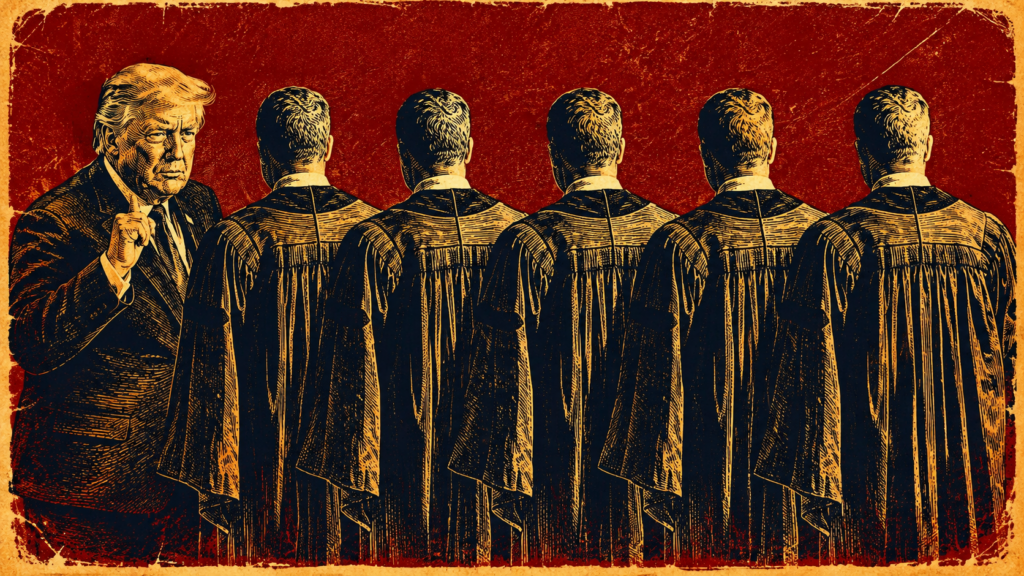
Trump Shapes Courts With Younger Judges
President Donald Trump is increasingly shaping the federal judiciary by placing younger judges on the bench, creating the possibility that many of his appointees could remain in federal courtrooms for several decades. The strategy has become a significant part of his second-term judicial agenda as his administration continues to nominate candidates to lifetime federal judgeships.
Article III federal judges are appointed by the president and confirmed by the Senate, and they generally serve lifetime terms unless they retire, resign or are removed through impeachment and conviction. That makes the age of judicial nominees particularly significant: a judge appointed at a relatively young age can potentially influence federal law for decades after the president who nominated them has left office.
Trump’s approach has included nominees who are considerably younger than many traditional federal judicial candidates. The emphasis on younger nominees means the administration is not simply seeking to fill existing vacancies. It is also attempting to establish a long-term judicial legacy through judges who could remain on the federal bench well into future administrations.
As of October 1, 2026, Trump had 56 Article III judges confirmed during his second term, according to a review of judicial appointments. That figure included 10 judges on federal courts of appeals and 46 district judges. The number places Trump’s second-term appointment pace below that of some recent presidents at the same point in their second terms, but the long-term effect of individual appointments depends not only on the number of judges confirmed but also on their ages, courts and positions.
The appellate appointments are particularly consequential because federal courts of appeals handle appeals from federal district courts and generally provide the final word in most federal cases that do not reach the Supreme Court. Appellate judges can therefore influence legal doctrine across entire regions of the country.
Trump has continued making appellate nominations in 2026. On October 1, for example, he nominated Mississippi attorney Todd Butler to the U.S. Court of Appeals for the Fifth Circuit following the planned retirement of Judge Leslie Southwick. The Fifth Circuit covers Louisiana, Mississippi and Texas and already has a majority of judges appointed by Republican presidents.
The administration has also continued filling district court vacancies. On September 14, the White House sent numerous nominations to the Senate, including candidates for federal district courts in Tennessee, North Dakota, Kentucky, Texas, Louisiana, Florida, Alaska, Oklahoma and Missouri, as well as a nominee for the Eighth Circuit.
The Senate confirmation process remains an important part of the strategy. A presidential nomination alone does not place a judge on the federal bench. The Senate must confirm the nominee, and the Judiciary Committee typically conducts hearings before the full Senate considers confirmation.
Some recent nominees have faced scrutiny over their legal records, judicial philosophy and prior public statements. For example, the Senate Judiciary Committee questioned several nominees in late September as the administration pushed to advance confirmations before the November midterm elections.
The age of judicial nominees matters because federal judges do not have fixed terms. Unlike members of Congress or a president, Article III judges can remain in office for life. A younger nominee therefore has the potential to influence court decisions long after the administration that selected them has ended.
That dynamic is particularly important when a president’s nominees are concentrated on appellate courts. Decisions from those courts can establish binding precedent throughout their geographic jurisdictions unless the Supreme Court later intervenes.
The Trump administration’s judicial appointments are also taking place against the backdrop of a federal judiciary that has frequently reviewed and sometimes blocked executive actions. Federal judges have issued rulings in cases challenging actions by the administration, while the Supreme Court has also ruled against some administration policies. The independence of judges appointed by Trump has consequently become a subject of public debate.
The fact that a judge is appointed by a particular president, however, does not legally make that judge an agent of the president. Once confirmed, federal judges exercise independent judicial authority and are expected to decide cases according to the Constitution and applicable law. Recent decisions involving Trump’s own Supreme Court appointees illustrate that judicial nominees do not necessarily rule in accordance with the preferences of the president who appointed them.

Trump’s first term already had a substantial impact on the federal judiciary. He appointed three Supreme Court justices—Neil Gorsuch, Brett Kavanaugh and Amy Coney Barrett—who helped establish the Court’s current conservative majority. His first administration also appointed numerous judges to the federal appellate and district courts.
The second-term strategy is different in one important respect: the Supreme Court has no current vacancy, while opportunities remain in the lower federal courts. That means the administration’s ability to influence the judiciary increasingly depends on appellate and district court appointments.
The Senate’s confirmation calendar could also affect the pace of those appointments. Several nominations submitted in September and October are awaiting Senate action, while the chamber’s schedule surrounding the November midterm elections could limit the time available for confirmations before the end of the year.
For the legal system, the long-term significance of these appointments will depend on how individual judges rule once they take office. Their decisions could affect constitutional rights, administrative law, criminal justice, environmental regulation, immigration, labor disputes, business regulation and numerous other areas of federal law.
The central legal consequence of Trump’s strategy is therefore not simply the number of judges confirmed. It is the potential duration of their service. Younger judges who receive lifetime appointments can remain on the bench across multiple presidential administrations, making judicial appointments one of the most enduring ways a president can influence the federal government.
As Trump’s second term progresses, the confirmation of younger nominees could consequently become an important measure of his long-term impact on the federal judiciary. The Senate’s decisions on pending nominations, the availability of future vacancies and the eventual rulings of the judges themselves will determine how that influence develops.

Key Legal Outcome
- Trump has had 56 Article III judges confirmed during his second term through October 1, 2026.
- Those confirmations include 10 federal appellate judges and 46 district judges.
- The administration continues to nominate judges for both appellate and district courts.
- Younger nominees could potentially serve on the federal bench for decades because Article III judges generally have lifetime tenure.
- Several additional judicial nominations remain before the Senate for consideration.
Why It Matters
- Lifetime appointments can extend a president’s judicial influence well beyond a presidential term.
- Appellate judges can establish binding precedent across large geographic regions.
- Younger judges may remain influential across multiple future administrations.
- Senate confirmations will determine how many additional vacancies Trump can fill.
- The judges’ eventual decisions—not simply their presidential appointments—will determine their legal impact.
