
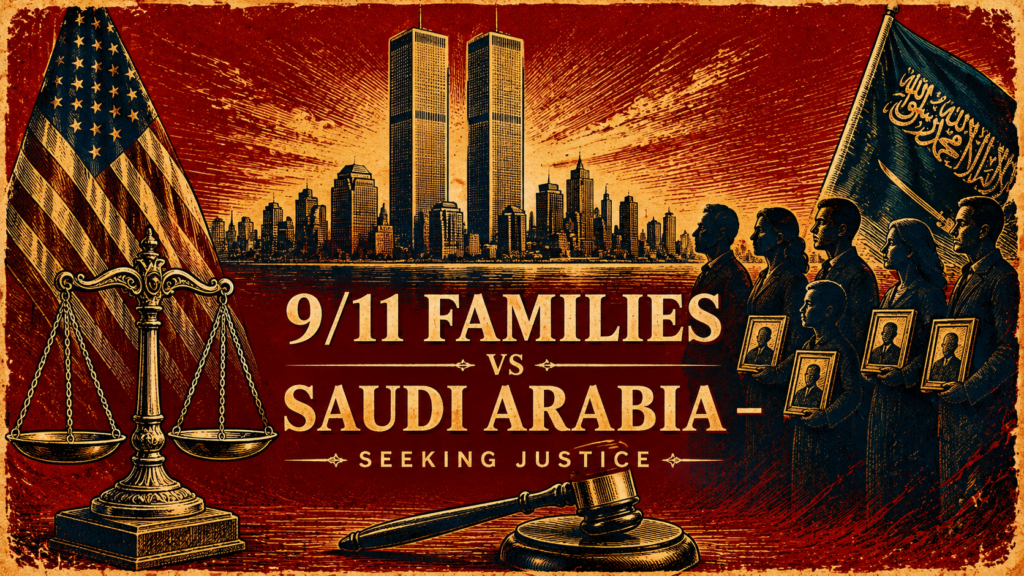
Court Hears 9/11 Families’ Saudi Arabia Case
More than 25 years after the September 11, 2001, terrorist attacks, families of victims and other plaintiffs are continuing their effort to hold Saudi Arabia legally responsible for alleged support provided to members of al-Qaeda and several of the hijackers. On October 7, 2026, a federal appeals court in New York heard arguments over whether the long-running civil lawsuit can proceed against the Kingdom of Saudi Arabia.
The case is being considered by the U.S. Court of Appeals for the Second Circuit in Manhattan. The hearing focused primarily on whether Saudi Arabia should be protected from the lawsuit by sovereign immunity, rather than on whether the country has ultimately been proven responsible for the September 11 attacks. The three-judge panel questioned lawyers representing both Saudi Arabia and the victims’ families but did not indicate how or when it would rule.
The litigation has been pending for more than two decades. Families, survivors, businesses and insurance companies allege that individuals connected to the Saudi government provided assistance to at least some of the hijackers before the attacks. Among the allegations is that Saudi nationals who were connected to the country’s government or intelligence services helped two of the hijackers after they arrived in the United States.
One figure central to the litigation is Omar al-Bayoumi, a Saudi national who interacted with two of the 19 hijackers, Khalid al-Mihdhar and Nawaf al-Hazmi. The plaintiffs contend that his activities, including helping the men obtain housing and other assistance, support an inference that he was acting as part of a broader Saudi support network. Saudi Arabia disputes the allegations and has consistently denied that its government supported the September 11 attacks.
The legal history of the case is complicated. The lawsuit was initially dismissed in 2015, but that decision was later overturned on appeal. Congress subsequently enacted the Justice Against Sponsors of Terrorism Act, commonly known as JASTA, which created an avenue for victims of international terrorism to bring certain civil claims against foreign states accused of providing material support to terrorist attacks on U.S. soil.
JASTA has become an important part of the plaintiffs’ effort to overcome traditional sovereign-immunity protections. Under the statute, victims can pursue certain claims involving foreign governments when the statutory requirements are satisfied. The law has allowed the 9/11 litigation to continue despite Saudi Arabia’s argument that it should not be subject to U.S. jurisdiction.
In August 2025, U.S. District Judge George B. Daniels rejected Saudi Arabia’s request to dismiss the case. The judge determined that the plaintiffs had presented enough evidence for the claims to continue, including what the court characterized as reasonable evidence connecting Saudi government officials or agents to assistance provided to two of the hijackers. The decision did not determine that Saudi Arabia was liable for the attacks; it allowed the litigation to move forward.
Saudi Arabia appealed that decision to the Second Circuit. Its lawyers argue that the country should not be forced to defend itself in a U.S. civil trial because of sovereign immunity. They have also pointed to the historical relationship between the United States and Saudi Arabia, including cooperation against terrorism and al-Qaeda during the 1990s.

The plaintiffs take the opposite position. They argue that the evidence should be sufficient to allow their claims to proceed in a U.S. courtroom and that the protections of sovereign immunity do not prevent the case because of the specific terrorism-related allegations and the JASTA framework. The families have spent years seeking an opportunity to present their evidence at trial.
The appeals court hearing does not mean Saudi Arabia has been found responsible for the September 11 attacks. That distinction is legally important. The current proceeding concerns whether the plaintiffs have a viable legal path to pursue their claims against a foreign government. A decision allowing the case to continue would permit further litigation; it would not itself establish liability or award damages.
The broader case involves numerous plaintiffs and multiple legal claims. Court records show claims against Saudi Arabia that include allegations of aiding and conspiring with al-Qaeda, wrongful death, survival claims, assault and battery, conspiracy, intentional infliction of emotional distress and other causes of action. The consolidated litigation also includes claims brought under federal terrorism statutes and related legal theories.
Other defendants have also been involved in the sprawling litigation. Some parties, including Iran, the Taliban and al-Qaeda, have already been found in default, while the current appeal focuses on Saudi Arabia’s attempt to prevent the claims against the Kingdom from proceeding.
The timing of the hearing has added significance for the families. The proceeding came only weeks after the 25th anniversary of the September 11 attacks, which killed 2,977 people when 19 al-Qaeda hijackers seized four commercial airplanes and crashed them into the World Trade Center, the Pentagon and a field in Pennsylvania.
The litigation has become one of the longest-running legal efforts connected to the attacks. For families who have pursued the case since shortly after September 11, a ruling allowing the lawsuit to proceed could represent another major procedural step toward a potential trial.
The appeals court, however, still has to resolve the sovereign-immunity questions before the case can move forward against Saudi Arabia. The judges did not issue a ruling from the bench following the October 7 arguments. The court is expected to issue a written decision at a later date.
For now, the central legal question remains whether the plaintiffs can maintain their claims against Saudi Arabia in U.S. federal court. The outcome could have broader implications for the ability of victims of terrorism to pursue civil claims against foreign governments and for the application of JASTA in cases involving alleged state support for terrorist organizations.

Key Legal Outcome
- The Second Circuit heard arguments over whether the Saudi Arabia lawsuit can proceed.
- Saudi Arabia is seeking protection under sovereign-immunity rules.
- A 2025 federal ruling allowed the claims against Saudi Arabia to continue.
- The appeals court did not issue a ruling after the October 7 hearing.
- The case concerns alleged Saudi support for hijackers, but Saudi Arabia has not been found liable for the attacks.
Why It Matters
- The case could determine whether 9/11 families get a chance to pursue a civil trial against Saudi Arabia.
- It tests the reach of the Justice Against Sponsors of Terrorism Act.
- The ruling could clarify limits on foreign-government sovereign immunity.
- The litigation has continued for more than two decades.
- The decision could influence future terrorism-related lawsuits against foreign governments.
Related:
