
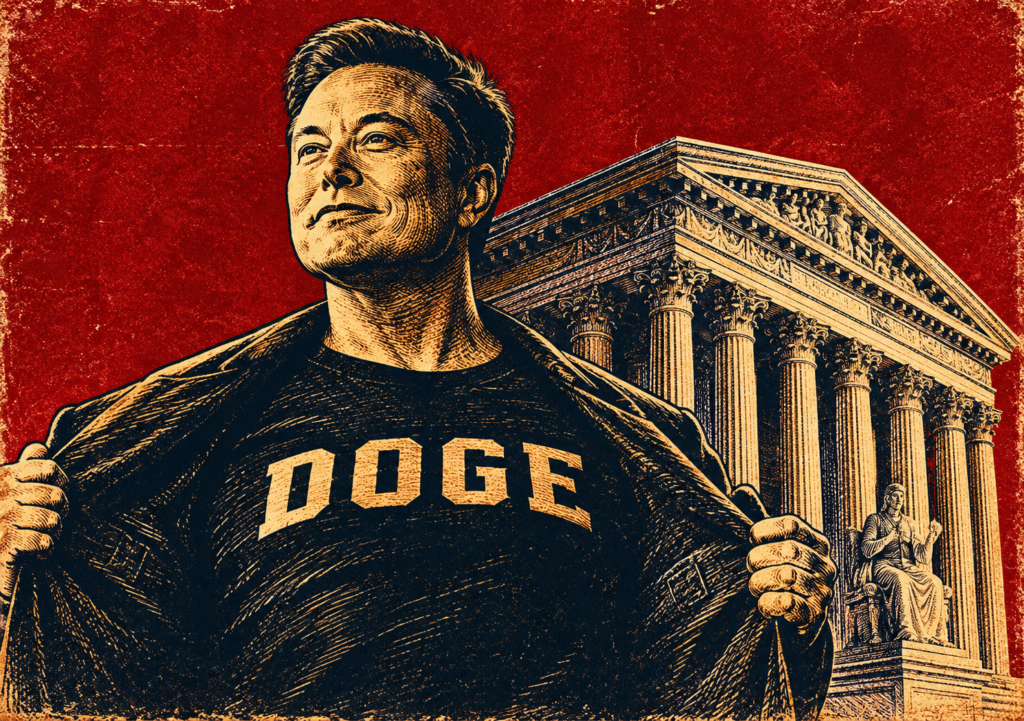
Supreme Court Weighs Public Access to DOGE Records
The United States Supreme Court has agreed to hear a legal dispute over whether the public can obtain government records concerning the Department of Government Efficiency, known as DOGE, an initiative initially led by billionaire entrepreneur Elon Musk during the early months of President Donald Trump’s second term. The case centers on a lawsuit brought by Citizens for Responsibility and Ethics in Washington, a government accountability organization seeking access to documents about DOGE’s activities. The court’s decision to take up the case marks another important stage in a dispute over government transparency, executive authority and the limits of public access to records associated with presidential advisers.
DOGE was established in January 2025 as part of the Trump administration’s effort to reduce federal spending, streamline government operations and restructure parts of the federal workforce. Musk became its most prominent public figure and helped lead efforts to identify spending reductions and change the operations of federal agencies. The initiative attracted significant attention because of the scale and speed of its proposed changes, its access to government systems and data, and questions about how its decisions were made. The records sought by the watchdog organization could help clarify DOGE’s internal operations, decision-making processes and relationship with federal agencies during this period.
The lawsuit relies on the Freedom of Information Act, commonly known as FOIA, a federal law that generally gives members of the public the right to request records from executive branch agencies, subject to statutory exemptions. Citizens for Responsibility and Ethics in Washington argues that DOGE functioned as a federal agency with substantial independent authority and therefore should be required to respond to relevant public records requests. The organization maintains that understanding how DOGE operated is important because its work affected government spending, personnel and agency operations. It contends that the public should be able to examine records that reveal how decisions with broad consequences were developed and implemented.
The Trump administration takes a different position. Government lawyers argue that DOGE operated as an advisory body serving the president rather than as an independent federal agency subject to FOIA’s disclosure requirements. Presidential advisers have traditionally received certain protections intended to preserve confidential discussions and allow the president to obtain candid advice. The administration maintains that forcing such advisers to disclose internal materials or submit to extensive evidence-gathering procedures could undermine executive branch independence. The legal dispute therefore involves not only the status of DOGE itself but also the boundaries between public accountability and the confidentiality of presidential decision-making.
Lower federal courts previously sided with the watchdog organization at key stages of the case. In April 2025, a federal district judge concluded that DOGE likely qualified as a federal agency for purposes of the dispute and ordered expedited processing of the organization’s records request. The proceedings also included permission for the plaintiffs to seek sworn testimony from DOGE’s acting administrator, Amy Gleason. That testimony could help establish the organization’s structure, responsibilities and degree of independent authority. The administration challenged these requirements, arguing that the lower courts had imposed obligations that went too far into protected executive branch deliberations.

The Supreme Court had already intervened in the dispute in 2025. In June of that year, the justices narrowed an earlier order requiring the government to produce DOGE-related records, concluding that the lower court’s approach was too broad. The court directed further consideration of the scope of the evidence that could be required. That earlier intervention did not finally resolve whether DOGE should be treated as an agency under FOIA. Instead, it shaped the subsequent proceedings and set limits on how the lower courts could approach the records dispute. The administration now argues that the appeals court failed to give sufficient weight to the constitutional separation of powers and the confidentiality of presidential advisers.
The current appeal asks the Supreme Court to review the legal framework governing the government’s obligations in the case. The administration objects to the extent of the requested discovery, including the possibility of compelling a deposition of Gleason under oath. Government lawyers contend that allowing extensive discovery into the work of presidential advisory bodies could interfere with executive functions and undermine established protections. The watchdog organization responds that the lower courts followed the Supreme Court’s earlier instructions and that the requested information is necessary to determine whether DOGE exercised authority that would make it subject to FOIA. These competing positions will help define the evidence that may be gathered before the underlying legal question is resolved.
A central issue is how the law distinguishes a body that advises the president from an entity that exercises independent governmental authority. The administration emphasizes DOGE’s advisory role and argues that the protections afforded to presidential advisers should apply. The watchdog organization points to DOGE’s broad involvement in federal operations and argues that its activities went beyond providing recommendations. Resolving that distinction may require the court to consider the organization’s actual responsibilities, its relationships with other agencies, the authority it exercised and the legal significance of its structure. The outcome could influence how future presidential initiatives are organized and how their records are treated under federal disclosure laws.
The case also raises questions about the balance between transparency and executive privilege. Public records laws are intended to help people understand government decisions and hold public institutions accountable, but they contain exceptions designed to protect specified interests, including certain confidential executive communications. The challenge is determining which protections apply to DOGE’s records and how broadly they should be interpreted. A ruling that expands access could strengthen public oversight of government initiatives, while a ruling favoring the administration could reinforce the confidentiality available to presidential advisory bodies. The implications will depend on the precise legal reasoning and the scope of any final decision.
For journalists, researchers, watchdog organizations and members of the public, the records could provide information about how spending reductions were proposed, which agencies were affected and how operational decisions were carried out. Such information could help clarify the relationship between DOGE’s public claims and its internal processes. However, the lawsuit does not itself establish that DOGE acted unlawfully, and the request for records should not be treated as evidence of wrongdoing. Its immediate purpose is to determine what information must be disclosed and what legal procedures may be used to establish the organization’s status. Any conclusions about specific decisions would need to be supported by the records and other reliable evidence.
The Supreme Court’s decision to hear the case means the dispute will continue, with arguments and a ruling expected during the court’s current term, potentially by the end of June 2027. The justices have not yet issued a final decision on whether DOGE is subject to FOIA or on the full scope of permissible evidence-gathering. The outcome could establish an important precedent for future disputes involving presidential advisory bodies, government transparency and the public’s right to examine federal operations. Until the court rules, the competing legal positions remain unresolved, and the immediate question is how far the watchdog organization may go in obtaining the records needed to support its case.

Key legal outcomes
-
Supreme Court review accepted: The justices agreed to hear the Trump administration’s appeal concerning access to DOGE records.
-
FOIA coverage remains unresolved: The court has not yet issued a final ruling on whether DOGE qualifies as a federal agency subject to the Freedom of Information Act.
-
Earlier disclosure order narrowed: In June 2025, the Supreme Court limited an earlier order requiring the government to produce DOGE-related records.
-
Discovery remains contested: The administration challenges the lower court’s authorization for a sworn deposition of acting DOGE administrator Amy Gleason, while the watchdog group argues that the evidence is necessary.
-
Final decision still pending: The case is expected to be argued during the court’s current term, with a ruling potentially arriving by June 2027.
Why it matters
-
Government transparency: The ruling could determine how much information the public can obtain about major federal initiatives and their decision-making processes.
-
Limits of presidential authority: The case examines the boundary between presidential advisory functions and activities that may qualify as independent government operations.
-
Public accountability: Access to DOGE records could help researchers and oversight organizations examine decisions affecting government spending, staffing and agency operations.
-
Future FOIA disputes: The court’s interpretation could influence how disclosure laws apply to future presidential advisory bodies and government efficiency initiatives.
-
Executive branch confidentiality: The decision may clarify how courts balance the public’s interest in government records against the need to protect confidential presidential advice.
