
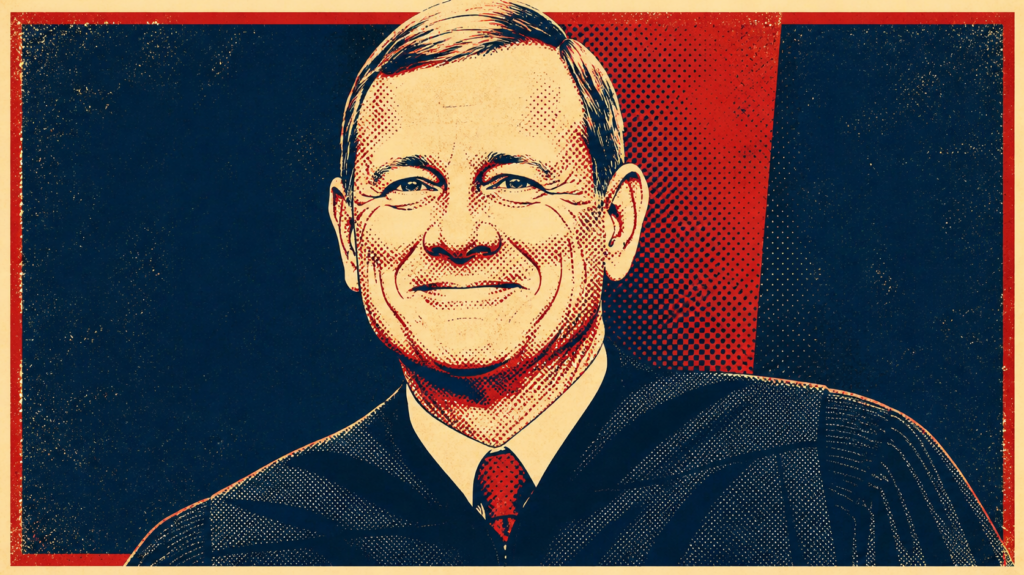
Chief Justice John G. Roberts
Name: John Glover Roberts, Jr.
Current Role: Chief Justice of the United States
Start Date: September 29, 2005
Appointing President: George W. Bush
Birth Details: Born January 27, 1955, in Buffalo, New York
Family: Married Jane Sullivan in 1996, they have two children, Josephine and Jack
Career Overview
John G. Roberts, Jr. is the 17th Chief Justice of the United States and the presiding officer of the Supreme Court. He assumed office on September 29, 2005, after being nominated by President George W. Bush.
Roberts came to the Court after service in private appellate practice, the Justice Department, the White House Counsel’s Office, the Office of the Solicitor General, and the U.S. Court of Appeals for the District of Columbia Circuit. His career has been closely tied to federal appellate litigation and constitutional law.
As Chief Justice, Roberts leads the federal judiciary’s highest court, presides over public sessions and private conferences when present, and oversees important administrative functions of the federal court system.
Public Service
Roberts served as a law clerk to Judge Henry J. Friendly of the U.S. Court of Appeals for the Second Circuit from 1979 to 1980. He then clerked for then-Associate Justice William H. Rehnquist during the Supreme Court’s 1980 Term.
He served as Special Assistant to the Attorney General of the United States from 1981 to 1982 and as Associate Counsel to President Ronald Reagan in the White House Counsel’s Office from 1982 to 1986. He later served as Principal Deputy Solicitor General from 1989 to 1993.
Roberts was appointed to the U.S. Court of Appeals for the D.C. Circuit in 2003. He served there until 2005, when he became Chief Justice of the United States.
Law Firm Experience
Roberts practiced law in Washington, D.C., from 1986 to 1989 and again from 1993 to 2003. His private practice focused heavily on appellate advocacy and Supreme Court litigation.
Before joining the Supreme Court, he was known as one of the country’s leading appellate lawyers. His work before the Court and in federal appeals courts helped shape his reputation for precise briefing, careful oral argument, and command of federal legal doctrine.
Education and Early Life
Roberts was born in Buffalo, New York, on January 27, 1955. He received an A.B. from Harvard College in 1976 and a J.D. from Harvard Law School in 1979.
At Harvard Law School, he served as managing editor of the Harvard Law Review, according to public biographical materials.
Major Cases and Actions
Roberts has written several major Supreme Court opinions involving health care, voting rights, race-conscious admissions, criminal procedure, and presidential power.
In National Federation of Independent Business v. Sebelius in 2012, Roberts wrote the controlling opinion upholding the Affordable Care Act’s individual mandate as a valid exercise of Congress’s taxing power, while limiting Congress’s ability to require states to expand Medicaid.
In Shelby County v. Holder in 2013, Roberts wrote the majority opinion striking down the Voting Rights Act’s coverage formula for federal preclearance. The decision had major consequences for federal oversight of state and local election law changes.
In King v. Burwell in 2015, Roberts wrote the majority opinion preserving Affordable Care Act tax credits for eligible people using federally facilitated health insurance exchanges.
In Students for Fair Admissions v. Harvard and Students for Fair Admissions v. University of North Carolina in 2023, Roberts wrote the majority opinion limiting the use of race-conscious admissions programs in higher education.
In Trump v. United States in 2024, Roberts wrote the majority opinion holding that former presidents have immunity from criminal prosecution for some official acts, no immunity for unofficial acts, and at least presumptive immunity for certain official conduct.
Publications
No full-length book authored solely by Roberts was publicly confirmed.
Roberts wrote the foreword to Courtwatchers: Eyewitness Accounts in Supreme Court History, a 2011 book by Clare Cushman about the Court’s history as seen through first-person accounts.
As Chief Justice, Roberts also issues the annual Year-End Report on the Federal Judiciary, a public report addressing the federal courts, judicial administration, and issues affecting the judiciary.
Public Image and Focus
Roberts is often associated with institutional concerns about the Supreme Court’s public standing and the independence of the federal judiciary. His opinions and public reports frequently emphasize judicial role, separation of powers, and the courts’ place within constitutional government.
His tenure has also been politically and legally controversial. Supporters describe him as a disciplined legal writer and institutional steward. Critics point to major decisions on voting rights, campaign finance, affirmative action, abortion, and presidential power as evidence that the Roberts Court has moved federal law sharply in a conservative direction.
Fast Facts
- 17th Chief Justice of the United States.
- Took office on September 29, 2005.
- Nominated by President George W. Bush.
- Born January 27, 1955, in Buffalo, New York.
- Earned an A.B. from Harvard College in 1976.
- Earned a J.D. from Harvard Law School in 1979.
- Clerked for Judge Henry J. Friendly and Justice William H. Rehnquist.
- Served on the U.S. Court of Appeals for the D.C. Circuit from 2003 to 2005.
- Wrote major opinions in Affordable Care Act, voting rights, affirmative admissions, and presidential immunity cases.
- No solely authored full-length book was publicly confirmed, but he wrote the foreword to Courtwatchers.

