
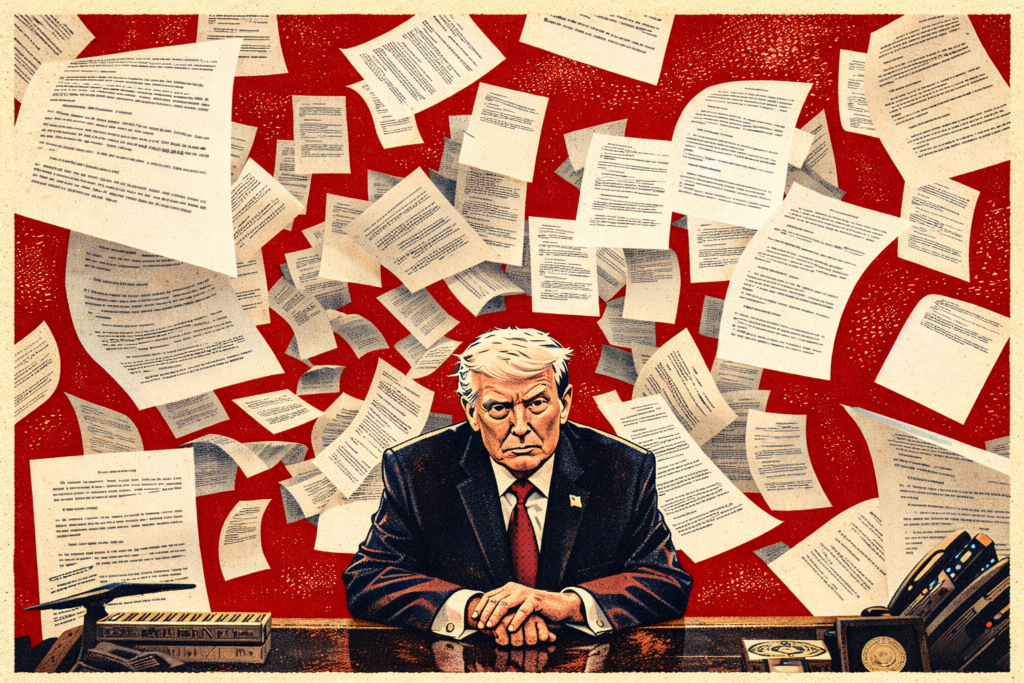
DOJ Rejects Presidential Records Transparency Law
A recent opinion from the U.S. Department of Justice (DOJ) under President Donald Trump has triggered renewed concerns about government transparency and presidential accountability. The controversy centers on the DOJ’s conclusion that the Presidential Records Act (PRA)—a post-Watergate law requiring presidents to preserve and eventually transfer official records to the National Archives—is unconstitutional.
The MaddowBlog article frames this development as “another blow” to White House transparency, arguing that the DOJ’s stance represents a dramatic departure from decades of bipartisan practice. Since its enactment in 1978, the PRA has served as a cornerstone of government accountability, ensuring that presidential records are treated as public property rather than personal assets. The law was specifically designed to prevent abuses like those seen during the Watergate scandal, when President Richard Nixon attempted to retain control over his records.
According to the DOJ’s legal opinion—authored by Assistant Attorney General T. Elliot Gaiser—the PRA exceeds Congress’s constitutional authority. The memo argues that requiring the president to preserve and transfer records interferes with the executive branch’s independence. In essence, the DOJ claims that Congress cannot mandate how a president manages internal documents, framing the issue as a separation-of-powers conflict.

Critics, however, see the move as a significant erosion of transparency safeguards. The MaddowBlog piece emphasizes that if the PRA is deemed unenforceable, presidents could potentially decide which records to keep, destroy, or conceal—raising fears about the loss of historical documentation and public accountability. This concern is heightened by Trump’s past controversies involving recordkeeping, including allegations that he mishandled or retained official documents after leaving office during his first term.
The article also connects the DOJ’s position to broader patterns in the Trump administration regarding openness and oversight. By rejecting a long-standing legal framework, the administration is seen as expanding executive power while weakening mechanisms that allow historians, journalists, and the public to scrutinize presidential actions. Transparency advocates argue that such a shift could make it significantly harder to investigate misconduct or understand key decisions made during an administration.
Legal experts and watchdog organizations have reacted strongly. Some have already initiated lawsuits seeking to affirm the PRA’s constitutionality and prevent the administration from disregarding it. These legal challenges argue that the DOJ’s interpretation contradicts established Supreme Court precedent and undermines Congress’s authority to preserve the historical record of the presidency.
The implications extend beyond Trump’s presidency. If courts ultimately accept the DOJ’s reasoning, future presidents—regardless of party—could gain greater discretion over their records. This could fundamentally alter how presidential history is documented and accessed, potentially limiting what future generations can learn about government decision-making.
On the other hand, supporters of the DOJ’s view argue that the executive branch must retain autonomy to function effectively. They contend that excessive legislative oversight could interfere with presidential duties and decision-making processes. However, critics counter that transparency laws like the PRA are essential checks on power, particularly in a system designed to balance authority among branches of government.
Ultimately, the controversy underscores a critical legal and constitutional question: who controls the historical record of the presidency? As the issue moves toward the courts, it is likely to become a defining test of the balance between executive authority and public accountability in modern American governance.

⚖️ Key Legal Outcomes
- The DOJ issued a legal opinion declaring the Presidential Records Act unconstitutional.
- The opinion asserts that Congress cannot compel the president to preserve records.
- It frames the issue as a separation-of-powers conflict favoring executive authority.
- The stance could allow a president to retain or control official records independently.
- Lawsuits have been filed seeking to uphold the PRA and block the DOJ interpretation.
📌 Why It Matters
- Threatens government transparency and historical record preservation.
- Could weaken accountability mechanisms for presidential actions.
- Sets a precedent expanding executive power over public records.
- Impacts journalism, investigations, and public access to information.
- May reshape the balance of power between Congress and the presidency.
