
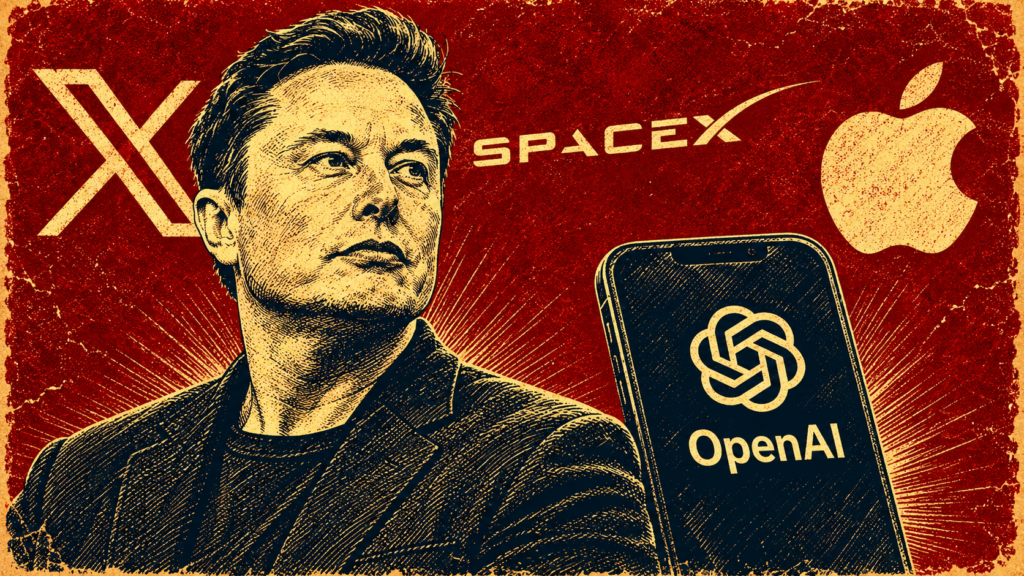
Musk Ends Antitrust Fight Against Apple
Elon Musk’s X Corp. and SpaceXAI have ended their antitrust litigation against Apple, bringing a significant chapter of Musk’s legal fight over competition in the artificial-intelligence and smartphone markets to a close. The companies filed to voluntarily dismiss their claims against Apple in federal court in Texas on September 14, 2026, and the court granted the request. However, the precise terms of the resolution have not been made public, and the available court filing does not establish whether Apple agreed to a financial settlement or made any business or policy concessions.
The lawsuit had placed Apple and OpenAI at the center of a broader dispute over how AI assistants are distributed through smartphones. Musk’s companies alleged that Apple and OpenAI had entered into an arrangement that unfairly favored OpenAI’s ChatGPT by integrating the chatbot into Apple’s AI ecosystem. According to the allegations, Apple’s relationship with OpenAI could make it more difficult for competing AI companies, including Musk’s xAI, to gain access to Apple’s enormous user base and compete effectively in the emerging generative-AI market.
The case was filed in 2025 and sought to portray Apple’s integration of ChatGPT into Apple Intelligence as an anticompetitive arrangement. Musk’s companies argued that the partnership effectively restricted competition in both the smartphone and AI-chatbot markets. The allegations were part of a wider confrontation between Musk and major technology companies over control of AI distribution, access to consumers and the competitive structure of the rapidly expanding AI industry.
The latest development does not, however, represent a complete end to the underlying legal dispute. X Corp. and SpaceXAI have indicated that they will continue pursuing their claims against OpenAI, which remains a defendant. This distinction is particularly important because the allegations concerning OpenAI’s conduct have not been resolved simply because the claims against Apple have been dismissed.
The court’s action also should not automatically be interpreted as a finding that Apple violated antitrust law. The dismissal ends the claims against Apple without a public judicial determination that Apple engaged in unlawful monopolistic conduct. The available reporting indicates that the filing did not explain the reasons for the dismissal or publicly disclose settlement terms. Bloomberg Law reported that U.S. District Judge Mark Pittman granted the voluntary dismissal, while Reuters likewise reported that the filing did not say whether a settlement had been reached.

The dispute had already generated important procedural developments before the latest resolution. Earlier in 2026, the Texas litigation involved disputes over discovery, including whether records associated with Musk’s business activities at other companies could be relevant to the case. A June court order found that certain communications from Musk’s accounts at Tesla and SpaceX could fall within the plaintiffs’ control and therefore be subject to discovery when relevant to the litigation. That illustrates how deeply the lawsuit had begun to involve Musk’s corporate network and internal communications.
The resolution with Apple comes at a particularly important moment for the technology industry. AI companies are increasingly competing not only on the quality of their models but also on distribution. Having an AI assistant built into a dominant smartphone platform can provide enormous advantages in user reach, default placement and consumer adoption. Apple’s decision to integrate ChatGPT into Apple Intelligence therefore became a major competitive issue for companies seeking to establish their own AI assistants.
For xAI, the dispute was also significant because Musk has been positioning the company as a major competitor in the AI market. Access to users is a central component of that strategy. Apple controls a large and valuable ecosystem of devices and services, making its policies toward competing AI assistants potentially consequential for xAI and other AI developers.
The end of the Apple portion of the case therefore removes one major legal front for Musk’s companies, but it does not eliminate the broader competition dispute. The continuing case against OpenAI could still test allegations concerning market power, AI distribution and the relationship between leading technology platforms and AI developers.
The immediate legal outcome is consequently narrower than the headline might suggest. Musk’s companies have withdrawn their claims against Apple, and the court has approved the voluntary dismissal, but there has been no publicly disclosed ruling establishing that Apple committed an antitrust violation. At the same time, the continued case against OpenAI means that the larger fight over competition in the AI ecosystem remains alive.
The case highlights a rapidly evolving legal question: how traditional antitrust principles should apply when powerful technology platforms control access to consumers while also partnering with leading AI companies. As AI becomes embedded in operating systems, search engines, social networks and other major digital platforms, disputes over preferential treatment, exclusivity and access could become increasingly important.
For now, Apple has exited this particular lawsuit, while OpenAI remains in Musk’s companies’ legal crosshairs. The next major development will likely depend on how the remaining claims against OpenAI proceed and whether the parties ultimately reveal more information about why the Apple claims were withdrawn and whether any private agreement was reached.
The core factual points above are supported by Reuters’ account of the September 14 filing, the American Bazaar Online report, Bloomberg Law’s report on Judge Mark Pittman granting the voluntary dismissal, and the earlier Texas court record concerning discovery.

Key Legal Outcome
- X Corp. and SpaceXAI voluntarily dismissed their antitrust claims against Apple, ending Apple’s role as a defendant in this portion of the litigation.
- U.S. District Judge Mark Pittman granted the voluntary dismissal in federal court in Texas.
- The public filing does not disclose the terms of the resolution, and it does not establish whether Apple paid a settlement or agreed to specific concessions.
- The dismissal is not a judicial finding that Apple violated antitrust law; the allegations against Apple therefore remain allegations rather than an adjudicated antitrust violation.
- The legal fight against OpenAI continues, meaning Musk’s companies have not abandoned the broader antitrust challenge surrounding AI competition and distribution.
Why It Matters
- AI distribution is becoming an antitrust battleground: The dispute shows that competition is increasingly about who controls access to consumers, not merely who develops the best AI model.
- Apple’s platform power remains central: Integration of AI assistants into a dominant smartphone ecosystem can significantly affect which AI products gain visibility and users.
- Musk’s legal strategy is narrowing but continuing: Apple is out of the case, but OpenAI remains a target, keeping the broader competition dispute alive.
- The case could influence future AI-platform disputes: Questions about exclusivity, preferred AI providers and operating-system access are likely to become more important as AI assistants become standard features.
- The undisclosed resolution leaves important questions unanswered: If there was a private settlement or business agreement, its terms could provide insight into why Musk’s companies chose to abandon the Apple claims.
