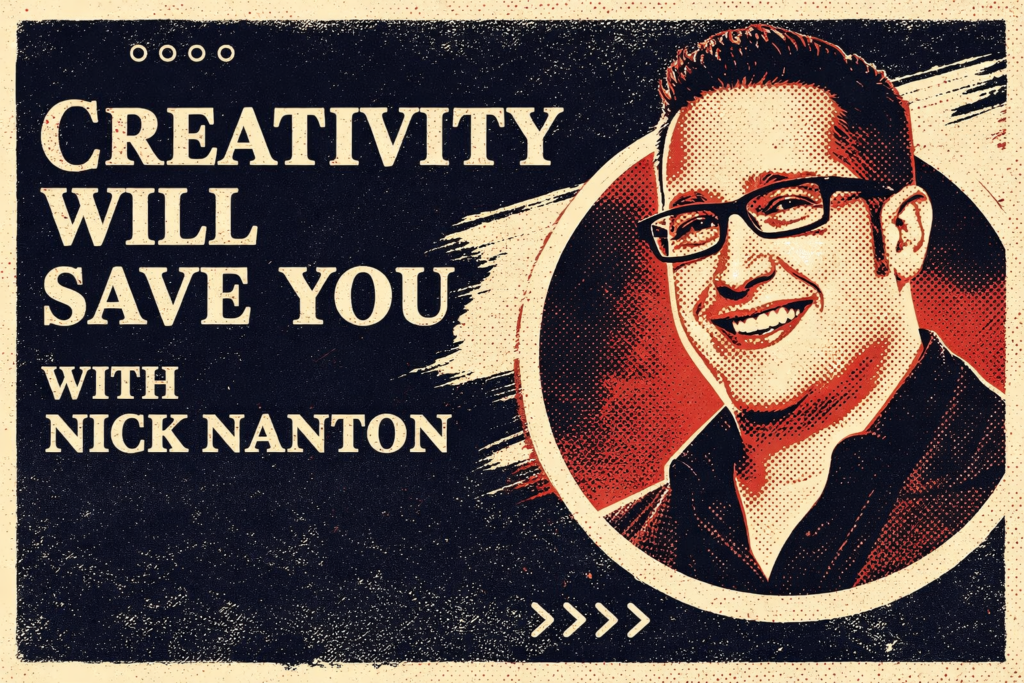
Nick Nanton Creativity Will Save You
LISTEN HERE:

BERT MARTINEZ:
Today on the show, Nick Nanton. Nick Nanton. I’ve known Nick for a few years now, and when I think about Nick, I think about storytellers. You know, I would say that there are storytellers and then there are visionaries who turn stories into transformation. And Nick Nanton is one of those rare souls. An immigrant, a lawyer, Emmy award winning director, producer, songwriter. He has done it all. He has told the stories and has interviewed the icons such as Peter Diamantes, Larry King, countless of individuals.
And I’m excited to have a chance to sit down and speak with Nick. Nick, welcome to the show.
NICK NANTON:
Thanks so much. Great to be here.
BERT MARTINEZ:
All right, so before we dive in, kind of give us a little bit of background about yourself as well. As I mentioned, I know that you’re an immigrant, if I remember correctly, from Barbados.
NICK NANTON:
That’s correct, yeah.
BERT MARTINEZ:
Yeah. And so kind of how did all this come about? Tell us a little bit about your background and how you went from lawyer to producer to songwriter.
NICK NANTON:
Yeah, I guess I’ll give you the. I’ll try to give you a good. An instructive, concise version. Look, first of all, I finally did them, like, figured it out a couple years ago that I was a really. Was a creative person who had to learn how to do business to be able to afford to be creative. Right. And I think that that’s. I’m not unique in that way.
NICK NANTON:
I think, I think most creative people would tell you that’s probably their path. I’ve been a. I started playing guitar at 6, started songwriting at 16, put in my first record at 18, started writing in Nashville at 20. So music has always been my first love and still is. And. But as an immigrant, you know, not that it’s just immigrants that do this, but certainly a lot of immigrant parents say, oh, look, they. If we give my parents, the respect is due.
NICK NANTON:
And then I’ll figure that out. Sorry. So if we give my parents the credit that they deserve, it is they made a lot of sacrifices to come here to give us, Give me and my brother, in this case, opportunity. And so they wanted to make sure that we were able to take advantage of that opportunity for our own sake. And probably in some cases, like, hey, we sacrificed so we want to make sure you do this. So they encourage us both to get professions, me and my brother. I have one brother, Andy, he’s two years older, he went to medical school and he’s a child forensic psychiatrist that’s boarded in five specialties and teaches at Stanford. That was not my path, but we both said, oh, we’re not going to go to get professions, whatever.
NICK NANTON:
He’s like an award winning playwright and other things, but now he practices medicine. And I was like, you know, okay, I get it. And I was like, you know, I know from reading books and watching. I knew a lot of CEOs of major corporations were lawyers. I knew a lot of people in the music industry. Presidents of record labels are. These were lawyers. I’m like, okay, I could do that.
NICK NANTON:
I finished undergrad and graduated within three years of going. So I had some time. Wasn’t quite ready to be done with college yet. So I went to law school. But I went. And even from the first day of law school, they sort of put you in small groups. What kind of law are you going to practice? I’m like, I’m not going to practice law. I’m not going to practice day of law in my life.
NICK NANTON:
They’re like, why are you here? And they were expecting me to be the guy on their left and their right. That wasn’t there when they graduated. But I did graduate. I did pass the bar exam. I am licensed to practice law. Thankfully, I don’t do it and I don’t have to do it and I don’t want to do it. And so I am. So I did all that.
NICK NANTON:
And then through the course of those things, I started working. I had met my business partner who’s retired now, Jack, but who you’d remember when I was 16 because my cousin dated his daughter in high school. And then When I was 2022, we ended up going to business together, building, starting an entertainment company together while I was in law school. I got out of law school, I landed a really big music job that promptly disappeared, actually right before I graduated from law school. But I had already moved and everything else. And so then Jack convinced me to come work with him while I was finishing law school at a sort of a financial company. Learned a ton about marketing. Was there about 3 years.
NICK NANTON:
Can’t work for anyone, can work with anyone, but there’s some other leadership at the time that I just couldn’t work for. And we’re all good friends now, which is how it works. So I end up starting. Jack convinced me to, to Start the celebrity branding agency utilizing my skill set from entertainment and his marketing skill set. Because music is just a really tough business and I don’t think it’s gotten any easier over the years. And so we started the agency. But then once the agency got successful, I think I was coming back from maybe my second Grammys. I went to 10 Grammys, nine of them in a row.
NICK NANTON:
And I was coming back and I was sort of frustrated, like I wasn’t any closer to getting a Grammy nomination. Everything I’d learned from the celebrity branding agency, you know, awards and positioning are valuable things, right? And so I started trying to figure out, what is that, man, I’m not getting closer to a Grammy. Like, I wonder what other awards I could win. And literally on the airplane, I googled how to win an Emmy. And I was like. And I found instructions. And the instructions were really basic, but it was simple. Things like, you know, everyone has access to amazing tools now, right? Because, you know, DSLRs were out digital SLR cameras.
NICK NANTON:
So like the cheapest, best quality, like you can make a film look like a film with a. Basically with a consumer camera for just a few thousand dollars instead of $100,000. Everyone had access to, you know, Final cut pro or even imovie, like non linear editing. It was like, so you gotta have a great story. Like that’s number one. And then like, make sure you seek help with entry. Like, one of the things I learned over the years is songwriting competitions. Anything and other things.
NICK NANTON:
A lot of times you lose the award before you even start because you perceive what a category might mean to somebody, they perceive it as something different. You know what, you can actually call and ask them. They’re not going to help you win the award, but they’ll help you enter correctly to make sure you’re not disqualified. So like, hey, think about that. That’s a good idea. And so I was on the lookout for a great story. I found a great story about a little boy who played T ball and had down syndrome, met his dad at an airport, long story short, ended up making that documentary grand. Got two Emmy nominations out of the region.
NICK NANTON:
We made it in, won my first Emmy. And my business partner Jack was like, you should do more of that. And so I started doing more of that and have really thankfully been able to build a career over the last 15 years. Now time flies. 2010 was my first one telling incredible stories about people who are changing culture. And that’s sort of how I got into telling stories. I’m still a songwriter as of Right now I’m currently ranked in the top 5% of songwriters in the world, which just means there’s a lot of really bad songwriters and, and, But I love it. It’s a blast.
NICK NANTON:
And I still write and got a bunch of stuff out with a bunch of artists. I’ve got a big record. I should have a few songs coming up on a big record too. So anyway, it’s been a blast. That’s awesome.
BERT MARTINEZ:
That’s awesome. And you know, it’s like, like you said, we’re, we’re immigrants as well. We came from Cuba and so.
BERT MARTINEZ:
Parents were definitely about work ethic. Find, you know, go to school, get that education so you could get that career. And, and back then, I remember I wanted to get. I wanted to get into filmmaking and my parents were saying, no, no, that’s not. Yeah, that’s pie in the sky. Nobody makes money out of that. I’m going, what are you talking about? Look at all these people.
NICK NANTON:
And, well, that’s. And that’s good advice, too. But just a couple things there that come to mind because I’ve been talking about this a lot recently. Number one, my oldest is now a junior in college, and I got this, actually, this wisdom from a book that Gino Wickman wrote. Gino wrote Traction as the founder of EOS Entrepreneur Operating System. He’s got a book called the Entrepreneurial Leap, which is a great book for children, adults, where it basically helps you figure out are you or are you not an entrepreneur? One’s not better than the other, but you’re going to be real frustrated if you think you’re on yarn or if you aren’t. Right. And so basically the wisdom comes down to.
NICK NANTON:
This is how I would discern it. Read the book. It’s wiser. But I basically told my son because it made sense. When I read something in the book, I’m like, you know, buddy, nobody really does what they study in college anyway, for the most part. I mean, unless you’re going to be a surgeon or, I mean, a lawyer sometimes, whatever. But undergrad, wide open, arguably, if you’re going to get into a profession. The more unique your undergrad is, as long as it qualifies you, probably the better.
NICK NANTON:
You might actually be more competitive to get in. So I said, I wish I would have thought of this. I got an undergrad in finance, which I’m not fascinated by at all. I said, hey, spend your undergrad studying something you’re absolutely fascinated with, and then we’ll figure out the rest. Like, I can help you start a business, I can help you meet people and get a job. I can help you with a lot of things in the professional world. What I can’t help you with is like figuring out what you’re really passionate about. Because if you do that, it will lead you somewhere and at least you’ll enjoy your years in college and you’ll be better, better off for doing it.
NICK NANTON:
Then we’ll figure out the rest. And so that’s number one. So I wish I’d have thought of that. Number two, it’s funny, someone the other day said to me, well, you know, I mean, someone told me because I mean, nobody makes money in documentaries. I’m like, well look, that is true in a lot of ways. But let’s like, let’s step back for a second because there’s everything from the documentary on being facetious right now on the micro pins in a USB plug that someone was fascinated by that they did for like a grad level PhD project that’s never going to make any money. And then there’s documentaries on, you know, 911 and the hunt for Osama bin Laden and Arnold Schwarzenegger’s life story and like, dude, there are docs that make a ton of money. So just like that, like a lot of people struggle in creative fields.
NICK NANTON:
Most of them aren’t great at business. And it does require luck, it does require talent, it does require skill, like a lot of those things. But like, let’s stop with the massive generalizations because every one of these things, like the thing that makes me comfortable about filming when I decided, because I actually decided to shut down my agency and go all in on film, which is like nerve wracking, like millions of dollars a year that we make. We’re saying no to that money to focus because I think I can be more effective here. And that’s nerve wracking. But the only thing that gives me comfort is like, you know what? This is an industry. It’s not something I’m creating, it’s something that already exists. I just have to play it smarter than a lot of other people.
NICK NANTON:
So yeah, so you just gotta be, you gotta play the game differently. I’ve never, I have never won a game by being completely better at anything than anyone else. That’s a big generalization. But let’s just at least use it for the point. My friend Sally Hogshead, she’s an incredible New York Times best selling author. She got a quote, different is better than better. I love it because how hard is it to be better? I’M never gonna be better at most things than the most gifted person on earth. I’m just not.
NICK NANTON:
There’s always someone better than you. There is so many. Why don’t I just be different? And if I’m different, I can stand out. I can figure out how to communicate with the audience. I’m trying to fascinate. I can try to use that language with the investors, the business people I know who might invest in something I’m working on, whatever it is, right? And so I would say focus on what you can be different at and find a way to carve your own lane.
BERT MARTINEZ:
And to that point, you look at, you know, I immediately thought of the pizza industry. For the most part, a pizza is a pizza is a pizza. And, and you look, Domino’s is different than, let’s say Pizza Hut, and Pizza Hut is different than Papa John’s. They’re still selling basically the same stuff, which is a pizza, right? And they all deliver, but they’re all slightly different. And I like this thing. I mean, to me, that, that right there is, is an awesome idea. Different is better. Now, how did you say it?
NICK NANTON:
Yeah, different is better than better. There’s a book called Fascinated by Sally Hogshead where she talks about that she did all the marketing for Jagermeister and a bunch of really unique brands and she realized, like, the thing, the thing people like. And again, I’m paraphrasing, read the book, but the thing people like about Jagermeister, nobody likes the way it tastes. Like there’s not a single person out there that goes, that’s delicious. What everyone loves about it is it’s a bonding experience to drink this terrible thing with your friends. And that’s actually what makes it sell. And so she leaned into that. It was never going to be better than, you know, Bailey’s or something like that, right? Like a caramel or milk liqueur is not going to be better.
NICK NANTON:
And so what can we do to make it stand out and make it carve its own path?
Bert Martinez:
And right there, I’m telling you, that is such a, I don’t know, mind blowing idea that, that different is better than better. Because everybody is trying to be better, but that is such a hard thing to do. Especially when, if you and I were going to compete with Apple, how are we going to compete with Apple? Not only do they have, whatever it is, 30, 40, 50 years in the market ahead of us, but their technology is awesome. And for us to get up to there is going to be incredibly expensive and hard. But can we be different than Apple. And the answer is yes, let’s figure out a way to be different. And that itself makes you better. Because people like different.
NICK NANTON:
They do. I’m going to turn my camera off and on. So we. Okay, we’re going to beat it. You’re absolutely right. And I didn’t validate this, actually. I’m at my studio right now and a friend of mine who worked for Red Bull staying here, I should ask him, but Red Bull, actually, my understanding is all the consumer feedback they got at first was it doesn’t taste good, so you need to change the flavor. What they ended up doing is leaning into the fact that it tastes like medicine, so it tastes like it’s doing something for you.
NICK NANTON:
And so that became like, they didn’t take consumer advice. They did. You know, I love the Steve Jobs quote. Like, you know, people don’t know what they want. You have to tell them. And so, you know, if we took everyone’s feedback, we’d end up with a soup nobody wants to eat. Right. Which is often what happens in the government and large corporations.
NICK NANTON:
Everything else like that. Someone has to have a vision and you need to take feedback on the vision and you understand how to position your vision, but without the visionary, you know, you know, seeing the vision through. This is where we get these soups nobody wants to eat.
BERT MARTINEZ:
Well into your point, everybody remembers the debacle of New Coke. They took that consumer advice and they tried to change the formula because they were afraid that they were losing a market share to Pepsi. And what happened? Massive backlash. They actually lost money. And all because they were trying to, quote, be better than Pepsi. And it’s like, you know, if you’re, if you’re a Cocaholic is like sometimes, sometimes like to call themselves, you know, if you like Coke, you like Coke, and if you like Pepsi, you like Pepsi. And how many times, you know, I remember in those Pepsi commercials where people, you know, they were doing the blind test and a lot of times the, according to commercials, people would pick Pepsi over Coke. But in the long, in the, in the long term, they didn’t switch people like Coke.
BERT MARTINEZ:
For whatever reason, they like Coke. And so back to this. Different is better than better. Not listening to that, to consumer advice. I think there was a. You probably know this. Isn’t there a rock and roll company out there called Cars? And that was like the least favorite name. Everybody hated the name Cars and that’s what they went with.

NICK NANTON:
We’re good. Sorry. All right. So we were just covering. Yeah, Red Bull and Then you said about cars. Yeah, I don’t know that story, but I have no doubt you’re right.
BERT MARTINEZ:
You know something else I want to talk to you about? I just, I. I want to confirm this. You are diagnosed with adhd, Correct?
NICK NANTON:
Okay.
BERT MARTINEZ:
And, you know, so am I. So, you know, it’s like to me that’s both. That can be good and bad. Right. A curse and a.
NICK NANTON:
What is it? A lesson occurs. Yes. Yes.
BERT MARTINEZ:
So how did that hinder you, like through school or through your career or how did that help talk about your adhd?
NICK NANTON:
Yeah, I think it hindered me when a teacher didn’t understand how I operate. Again, I just figured this out maybe a couple years ago now that I thought I hated learning. Like, for the most part, I didn’t hate school, but I didn’t love learning. But I thought learning was. I thought I didn’t love learning. I thought learning was sit me in a desk for eight hours a day and make me do worksheets or projects or whatever. What I’ve realized is I absolutely love learning, which is why I love documentaries, because I’m working with the best in the world every day and have the opportunity to learn things that fascinate me. And so it definitely hinders me in things.
NICK NANTON:
Like studying was interesting. So I remember my wife and I got married after my first semester of law school and my best friend who lived next door who was going to law school with me, he would come over to study with me sometimes and my version of studying is like 10 to 12 minutes and then we take a half hour break because my brain, I hyper focus and then I’m done with it and I can move on and. But like, that’s not the way most people study. And so my wife’s like, honey, Dave came over to study with you and you just keep getting like, she took my laptop away from me. She’s like, I felt like I had a mother and I was like, that’s just how I study. And so it’s funny now I see my oldest son do similar things and it’s just funny. So not understanding how. Not understanding how your brain works and not being given the space in a school setting to allow your brain to work that way, which actually I understand.
NICK NANTON:
I mean, the school system is set up for an industrial revolution, right? I mean, it’s set up for 30.
BERT MARTINEZ:
Set up for the masses, right.
NICK NANTON:
To do the same thing at the same time. And we’re going to move on this pace. It’s set up for average, Right. It’s not Good for below average. It’s not good for above average. And so it doesn’t mean we can’t succeed in it. But, you know, I, I did well in school because that was expected of me.
But I found ways. It’s really interesting. I’ve recently realized that I created a bunch of coping mechanisms to allow me to succeed in most areas of my life. And quite frankly, when it comes to learning in school, I realized I had negative opinions associated with most of those coping mechanisms because of the way I was meant to feel. For instance, you might have heard this before. And by the way, no indictment on the teacher. They didn’t know any better either.
BERT MARTINEZ:
Right?
NICK NANTON:
Right.
BERT MARTINEZ:
Absolutely.
NICK NANTON:
The teacher’s like, I finished my math quiz or test in 11 minutes and we had an hour for it. I take up a teacher’s desk. She’d be like, you can’t possibly have done this. Well, you need to go check your work. I’d go check my work. I’m now beyond my period of focus, of time. I can actually really focus, and I change the answers and I make them incorrect because I’m no longer focused. I’m like, I did this.
NICK NANTON:
I’m done with it. I put all my brain on it. Let me move on. Right. And I couldn’t. So. So, like, you know, I actually had my very first law school exam. I’m writing about this in my new book because, again, I realized, like you, I’m now processing these things.
NICK NANTON:
Like, oh, wait. And that’s why I feel this way about certain things. You just don’t think about it. You move on. And I finished my. We had three hours for our first law school exam, and I finished it in 37 minutes. And I. My buddy looked at me like, dude, are you quitting? Like, I knew you don’t want to practice law, but I’m like, no, I’m done.
NICK NANTON:
And I take it up. And I got a D plus in that exam, which I’m convinced the teacher was, was offended I finished. So I took him again, a different class. But by the way, D plus, it’s a pass. It’s a pass anyway. And, you know, it’s like, you got the bell curve A’s and F’s and B’s and D’s and C’s. Most everyone gets C’s. You should be smarter than, like 10 people.
BERT MARTINEZ:
People on top of that, even if you were going to practice law, it’s not like your clients are going to ask you, hey, how did you, you Know what was your GPA in law school? They don’t care. They just.
NICK NANTON:
And it’s not usually like what you learn in was particularly relevant anyway either. Right, Whatever. So. So I took him again and there’s. It came. And a lot of tests in law school are open book, fine. And it came down to this question at the end of it, and I’m like, man, I never heard this before, but I could figure it out. And I like went to like the index and I, oh, that sounds like that.
NICK NANTON:
And I went to it and I found a case in the textbook that was about the same thing. And then when I compared the two, it was literally the exact same case. He had just changed the names. So. So I copied the judge’s opinion and I changed the names. I got an A. And so I can play that game, buddy. All right, I got it.
NICK NANTON:
So anyway, when I asked my buddies, right, did you notice? They’re like, wait, the case was the same? Like, yeah, it’s the exact. Literally word for word, the exact same case. So anyway, you know, it’s so funny.
BERT MARTINEZ:
Because one of my coping mechanisms when I was in school was I would record, I would record the professor and then I would play it over and over and over again. Repetition, you know, was good for me in that sense.
NICK NANTON:
Yeah.
BERT MARTINEZ:
And then I, I was able to just spit it out verbatim in some cases. Right. And, and, and that worked for me. Writing, Writing works for me. Those are my favorite two ways of coping if I can write it and, and be able to go back to it. But I’m like you in the sense that once I’m, once my focus is burned out, I gotta take a break, I gotta get up and go do something and come back. Otherwise it’s just, it’s just like Charlie Brown.
NICK NANTON:
Right. And school is, is set up for that with like a lunch break and recess maybe. But you know, when it gets to 45 minute or one hour periods before you can take a break, I’m like, bro, I’m cooked. Like, this is not, this is not working for me. And so, yeah, it is interesting when you go through that one thing. So I’m working on a new book. I’m almost done with it. It’s called creativity protects you.
NICK NANTON:
It’s something that Dan Sullivan said to me from Dan of Strategic Coach during COVID that just, you know, struck me like a bolt of lightning. Like, oh, this has been my entire life. And I bet many of you it has been too. Cause I just, I’m using my language, I process Creativity as the unique. And again, I’m gonna use my language and everyone can use their own. The unique skills that God gave you that if you put em together, you can come up with solutions and answers no one else could ever figure out because they don, they weren’t made the way you were made. And so you call it the universe, whatever you want, I mean everyone listen, it applies. And the coolest thing about creativity is to lean into your creativity.
NICK NANTON:
You don’t particularly have to go buy anything new. In a lot of cases you just think more like you problem solve more like how do I get more out of this? And when we lean into that instead of running from it, which a lot of times we’ve either shut it in a box because we were discouraged, or it was too impractical, or you’re never going to make money in movies or like you, we’re with the best of intentions. We were given bad advice, right?
Because it had no context and they didn’t have the vision we have. Because when God gives you a vision, he doesn’t give it to everyone around you, gives it to you. And then you’ve got to enroll everyone around you into, into proving that that’s a viable answer and for good reason. Because we’ve all done a lot of stupid things that people love us, have watched us do. They’re worried when we do something stupid, right? And so one thing we talk about in the book is you cannot change what happened in your past, but you can change the way you process it as a massive. I’m no therapist, I’m sure my brother could speak this way better than me.
NICK NANTON:
But look, it stands to reason. We all have these things. We have negative, like negative associations with that make us sometimes even physically cringe when we think back to a moment. A breakup or a bad grade or got caught cheating or like whatever it is, right?
BERT MARTINEZ:
We all have whatever it is, right? The shame, the shame that goes with it all.
NICK NANTON:
All of you just go back and you choose to process it with gratitude. Had that terrible thing happen, had that breakup never happened, I never would have met this incredible person. Would that person, I mean as much as you, not have died in a car accident? I probably would have been way more careless with drinking and driving. Like find a way to process it so that you win in the end by what gratitude can I assign to that? And if I can assign some gratitude to that, like the tool chest opens wider and wider and it adds to your life experiences and your unique makeup, allow you to have solutions that no one else can understand or do. And that’s really when you lean into that. Those abilities are what will allow you to be the best in the world at something that’s really the only thing you’d ever be better at than anyone else because you were made for it and your experience led you to be able to do it. It.
BERT MARTINEZ:
I love that. I love that. Not only that, but you have full control how you edit that out. In fact, Tony Robbins teaches that, right? He’s, he’s. He’s really big about. If this still bothers you, then you got to go back in time and, and play funny music or, or do whatever. And I like this attitude of yours or this idea of yours of, of using it with gratitude. You got to finish the story and say, hey, because of this, I was able to get to hear.
BERT MARTINEZ:
And sometimes we just get stuck in this terrible memory or this bad memory, shame or guilt or whatever, and then we don’t really attach any meaning to it and sounds like what you’re saying. The same thing as Tony is you got to attach a meaning to it, a positive meaning, and kind of therefore use it as a springboard versus something that sucks you down.
NICK NANTON:
Absolutely. I love Tony, by the way. Just flew out to meet with him about a project a couple weeks ago. Hopefully that comes to fruition. Great. Great. Human also. Yeah, I would say that, you know, when it comes to all that, again, I have no PhD in this subject, but someone who does have a PhD explained post traumatic stress to me this way, which made the most sense to me, by the way. Post traumatic stress doesn’t always. It’s not just from war and military.
BERT MARTINEZ:
Right. I have five kids. I have ptsd.
NICK NANTON:
Right, exactly. Yes. Post traumatic stress happens from lots of things. But the best explanation of post traumatic stress to me is when war is a great example of it. So people I know who were in convoys and the big thing in the recent wars has been these improvised explosive devices, IEDs. So you got to keep your head on a swivel because you don’t know if that’s really a lunchbox or it’s going to send you to heaven or hell. You got no idea. Right.
NICK NANTON:
And so when they get back from that situation, they’re driving a regular road, their brain keeps revisiting that, but in the present, there’s nothing they can do about it. So that’s the torture. The torture is that your brain keeps telling you to deal with this situation, but there’s nothing in front of you that will allow you to deal with it. I’m like, oh, that makes sense to me. I understand how that is actually torturous. Like, your brain is saying, deal with this, deal with this. But there’s nothing to deal with. So you’re just caught in a loop.
NICK NANTON:
And so that, you know, that’s what a lot of us have done with, you know, post traumatic stress in our lives and with our upbringing, our teachers. And here’s the thing, most people, when it comes to storytelling, will say, I don’t have a story to tell. And it’s not true. Because what they’re doing is they’re comparing it to someone else’s story. Right? But what everyone needs to realize, and a lot of us would do this to our kids. What are you complaining about? You got running water, you got heat, you got Internet. Yeah, we didn’t know we used to have to walk uphill, whatever, right? But, like, your best thing, your best thing in your life is your best thing in your life. It’s always gonna be your best in your life.
NICK NANTON:
The best thing happening in your life right now is your best thing. The worst thing is the worst thing. It doesn’t matter what your neighbor’s best or worst thing is. You’re not equipped to deal with that because it’s not your best and worst thing. So these stakes, since every story takes stakes, well, the stakes are what’s happening between the best and the worst things. And so we all have these things that even if you would feel maybe embarrassed if you were in a group therapy session and someone was talking about the worst thing in their life was losing their mother to cancer at the age of six or whatever, and that’s terrible. But that was their worst thing. That’s not your worst thing.
NICK NANTON:
So you can’t downplay your worst thing because your worst thing creates trauma. It does. It’s your worst thing and you know it and your brain knows it. And so I just feel like in a lot of cases, I guess my life and my filmmaking, everything else has been the process of working with the best in the world. The Tony Robbins, the Dan Sullivan’s, the. You name them, it’s the Sally Hogsheads to sort of process these things and sort of, I think the meaning of life in many cases, you know, other than finding faith and other things that I think is the most important thing is like making sense of what. Of what you were given. Because we weren’t born with instructions, weren’t born with any level of experiences.
NICK NANTON:
You come in as a crying mess and you leave this crying mess, whatever, and that’s it. So what do we do to make sense of what happens in the middle? And I think, interestingly, I think entrepreneurs are sort of built to do that. I’m sure many other people are engineers, problem solvers, but, you know, I’m an entrepreneur, so I can speak to it from that. But I think a lot of times we’re not encouraged. I’ve been really blessed because the coaches, the people who I’ve been around, Dan Sullivan particularly, has encouraged that journey, as opposed to most. Most people’s journey, I think is yo. I mean, why are you talking about something that happened when you’re 6 years old? Get over it, work harder. Life’s great.
NICK NANTON:
You know, I mean, as a. When it is great, but doesn’t mean we don’t need to deal with the things that are bothering us, whatever they are.
BERT MARTINEZ:
Right into. To your point, if something is bothering you when you were 6 or 16, then I think that’s your body’s way or your spirit’s way or your mind’s way of saying, come back, let’s visit this and get it out of the way. So, yes, if it’s. Keep, you know, if you’re. You’re constantly visiting that, then it’s time for you to deal with it on some way.
And I think that it was Brene Brown. She’s done some really good work. And I think that the aha. That I got from her was dealing with vulnerability. That when. When people are talking about their stories, they hate talking about their failures. They hate talking about that big rejection or the fact that they filed bankruptcy four or five times.
NICK NANTON:
Right.
BERT MARTINEZ:
That vulnerability. But Brene says when you hear somebody talking about it up on stage and you look at that person talking about this, the situation, this horrible situation, and they’re just sharing from their heart, you’re going, wow, that person is so courageous. And we forget that is part of the story that, that one of the issues I have with social media is that everybody’s talking about, look, look at my beautiful car, my beautiful life, my beautiful jet. You know, life is amazing all the time. And. And then we come to find out, oh, this is fake and that’s rented, and this is, you know, you know, whatever, CPI or whatever. But the reality is you don’t want to read. You don’t really want to read a story that says, hey, I, you know, from the age of zero to today, life was just fantastic.
BERT MARTINEZ:
I never had.
NICK NANTON:
Yeah, yeah.
BERT MARTINEZ:
I want to know your worst. How did you get out of that hole? What did you do when your friend Betrayed you. What did you do after? As you said, your mother dies at the age of six. Let’s get into it. Because that’s where the inspiration. That’s where you go, wow,
NICK NANTON:
That makes me trust you. It’s like, oh, if we’re in a fox den together, I know you have that skill. Good. Thank you. Good to know. Because, you know, I think. And the other thing I think most of us are, whether we’re taught this or it just seems like the way things are inherently, like, we think we gotta know how to do everything. Like, we gotta be able to be experts on everything.
NICK NANTON:
When in reality, you really need to figure out one thing you can be different, perhaps better at than everyone else around you. And that provides value. Because I don’t want, like, I hope I never have to look at, you know, a QuickBooks. You know, when I ran a T shirt business in college, I had to do the invoicing. Like, I don’t ever want to see that again. And the person who does it for me, she. I guarantee you, she wakes up excited every day to make sure the QuickBooks and Voices are done, to make sure the debits match the credits, to make sure. Like, that gives her peace.
NICK NANTON:
Like that’s what she wants. Yes. I don’t want anything to do with that. And the beauty is recognizing that one is not better than the other. They’re symbiotic. And really, the way we achieve success in life, the only way I’ve achieved success in life is when I realized, man, I need the help of other people who are better than me at this. People who are like, I’m not a cinematographer. I can operate a camera pretty well, but I’ve never once woken up and saying, oh, my God, I can’t wait to put a camera on that.
NICK NANTON:
But I have my friends who are cinematographers. They’ll probably wake up in the middle of the night from asleep to go, oh, I got this amazing. I gotta go shoot this vase this way, or whatever. Like, that’s the man or the woman I want on my team. So that when I wake up with an idea on how to fund a film or a project I want to do or I want to meet with Tony. But you can’t do those things to the best of your ability if you’re trying to do 99 other things really well too. Now, how many things do we have to do in life? Like, you have to be pretty functional at quite a few things. But you’re talking professionally.
NICK NANTON:
It’s really great to just realize and Let go and say, man. Let me. There’s a friend of mine wrote a book called the Bezos Letters, and it’s basically Jeff Bezos Principles for Running Amazon that he distilled from all of his shareholder letters. And it’s brilliant. His name’s Steve Anderson. The book’s called the Bezos Letters. And there’s a Jeff Bezos principle that I use, and I love his. He basically says, never hire someone you don’t admire for anything.
BERT MARTINEZ:
I like that.
NICK NANTON:
Never. So, I mean, most of us would never, like. I never want to mow a lawn ever again in my life. I mowed so many lawns in high school and made money doing it and, like. But I admire the lawn crew that mows my yard and keeps it because they want it to be nice for me. They take pride in wanting my yard to be nice for me and my family and my guests. That’s the people I want. I don’t want somebody who just laissez faire.
NICK NANTON:
I gotta get it done. Gotta get the money. And you could many tasks that many of us would probably incorrectly assign some negativity to it as menial or beneath us or whatever. Like, it’s just that we don’t love it. Like, I know people who make more money than me by mowing lawns. Like, they just built a big enterprise doing. I live in Florida. Every lawn’s gotta be mowed every week.
NICK NANTON:
I mean, there’s some good money in this stuff if you could do it right. But it’s just, I don’t want to do it. I don’t want to clean my house. I don’t want to. I’m not a good handyman. I suck at it. Like, that’s just not my role. So I’m just going to hire someone who loves making it perfect.
NICK NANTON:
This right here behind me, These are all 2 inch felt squares. Now, this is my songwriting studio. I had it designed online into a Stop Record Play pause button. And the guy who put it up was so. I mean, this thing would have been a mess had I done it. It is completely square on all sides. Is completely. And he took such great joy in making it perfect.
NICK NANTON:
Like, he was obsessed with it in a great way. Like, I admire that. And he did a great job. And now it’s what I want. And I just have to be able to give him the value he needs in exchange to do that. In college, it was beer for playing guitar in my songs. Whatever. Now it’s probably money.
NICK NANTON:
Maybe it’s something else I have that’s a Value, whatever. But that’s how it works. And learn how to build the best teams that no one can beat.
BERT MARTINEZ:
Absolutely. No, I love that idea. Don’t hire somebody that you don’t admire. That’s a great, that’s a great philosophy right there. It, you’ll, you know, with that philosophy you will avoid so many headaches. Right. And I know that sometimes we’re looking for a cheaper way to go, but just because it’s cheaper doesn’t mean it’s going to save you money.
NICK NANTON:
No, they all say good, fast, cheap, choose two, right. And it’s, it’s pretty, pretty accurate.
BERT MARTINEZ:
That’s right, that’s right. When you, when you think of high quality, Walmart is not at the top of the list thinking I need something cheap. Boom. Walmart, man, Walmart. And not to put them down, Walmart.
NICK NANTON:
Is, they do it really well.
BERT MARTINEZ:
Yeah. However old they are 100 years old, they’ve spent, you know, millions of dollars being the low price leader in our mind, Walmart is the place you go to save bucks to get a, to find a ten dollar pair of shoes or a five dollar or five dollar shirt or whatever. There’s nothing wrong with that.
NICK NANTON:
It serves as a place in the market. I remember another mentor, my Dan Kennedy, incredible direct marketer.
BERT MARTINEZ:
I like Dan Kennedy. Yeah.
NICK NANTON:
Dan would say, you know, whenever he consulted for people, usually in small communities or whatever they would say he would try to get them to raise prices or add a level of luxury to. He’s like Dan, you understand my community. And he goes, well I got a question for you. Is the only store in business in your community Walmart? No. No. Are there any nice restaurants? Does anyone drive a late model car, perhaps a Mercedes or. Oh yeah. Okay then you’re missing it.
NICK NANTON:
Like they’re not. Everyone in the community is not looking for cheap. It’s your, your mental block on what people are willing to spend money for because, and at the time he would say this, you could drive through any trailer park in America and you will find Cadillacs and satellite dishes and you know, it’s sort of dated language but you’ll find Internet, you’ll find cars, you’ll find people find the money for the things they want that they find value in. So really, you know, I’ve been quoted for saying this before, but price is only an issue and value is a mystery. So it’s your job to figure out how to make it more valuable to people so they’ll pay the price you want. And if you can’t figure it out, that’s on you.
BERT MARTINEZ:
Absolutely. You know, it’s so funny because to this day, I still remember the first time I made $100,000 in a month. And that was a record breaking month. And I had a little bit of a challenge sleeping that night. It was the most money I’d ever made. And I was like, wow, this is incredible. And I was thinking about this and, you know, and all this stuff, and I was partly, I was very excited because I just hit a big threshold and. But at the same time, I’m like, man, you know, what else have I, you know, what else can, where else can I go with this? Or, you know, whatever? And it was just a sleepless night.
BERT MARTINEZ:
Most of it was good, but a lot of it was me still fighting some of these limiting beliefs. To your point, that is what holds us back. The difference between the guy who’s making 100 grand a year and the guy who’s making 100 grand a month is right here. And, and, and those limiting beliefs makes or breaks us. There are people who come here who do not speak English. As a matter of fact, one of my favorite stories, my, My parents had the first Spanish language paper in, in Houston, Texas. And my dad and my mom were in, you know, were involved in the community there and, and they got this call late at night and there was this guy from, I believe he was from Brazil and, or Argentina. And he basically, he spoke no English and barely spoke Spanish.
BERT MARTINEZ:
And so. But they had come here to Houston for some medical stuff for their child and that he had run out of money. And so basically with his bad Spanish, convince my dad to, to give him an opportunity to just sell advertising. Now he’s got no car, doesn’t understand English, barely speaks any real Spanish, and. And he became the number one salesperson within 30 days because he was so motivated and he wasn’t hung up on, I don’t have a car, I don’t speak the language. And he would disappear and then the next morning he would show up and he would have checks after checks after checks, and within like 90 days, he was, he was back on his feet. Life was great, and his son got better and they ended up moving back to where he was from. But I remember this guy, and I remember that story because it just opened my mind that when you’re really motivated, nothing stops you.
BERT MARTINEZ:
When you’re focused and you’re trying to achieve this one goal, obstacles melt. It doesn’t matter the language, it doesn’t matter your education, we hear it all the time. Immigrants that come here from nowhere, with barely no resources, and then within a few years, they’re multimillionaires.
NICK NANTON:
It’s true. And it reminds me of another story that Dan Kennedy told that I don’t remember the guy exactly, but the analogy, even if the story wasn’t 100% true, which I’m pretty sure it is, it would still stand. And basically this guy needed like a, some sort of like a heart transplant or something like that. And, and he wasn’t a doctor and didn’t have access and he just kept telling it was going to take longer than he had.
And he basically, well, what’s my skill set? Well, the guy was really good at writing sales letters, so he wrote a sales letter to get himself a heart and he ended up getting the heart transplant because he, instead of saying there’s nothing I can do, he’s like, well, what can I do with the skill set I was given and how might I approach this with the creativity that God gave me and let me really leave no stone unturned. For the most part, me included, I just get too lazy to turn over certain stones. Right. It’s just like, ah, well, life’s good enough that I just don’t need to do that.
And when it’s not, you know, as they say, necessity is the mother of all invention. Right. That dude figured it out. And I guarantee most of us would figure it out in the same situation too.
BERT MARTINEZ:
Absolutely. And I love this idea of coming back to, how did you say creativity protects you?
NICK NANTON:
Yep, yep.
BERT MARTINEZ:
Right. And that’s true. And sometimes I talk about this quite a bit. Sometimes we overlook the God given talents that we have. Right.
NICK NANTON:
You know, we always overlook them. Shaq doesn’t think it’s neat to, to be able to dunk a basketball.
BERT MARTINEZ:
Right.
NICK NANTON:
He was like, born that way. So like, if we didn’t struggle to attain the skill, we give it zero value.
BERT MARTINEZ:
Right?
NICK NANTON:
If we didn’t struggle it. Like I had one lady one time, we were doing stories for other these financial advisors, like mini films. She’s like, I don’t have a story. It’s not, we can’t do mine. And I was like, well, try me. And so you know what, let me just, let me make it. I bet you have a story. Turns out a lady, she was born in China, they have an earthquake, she lived in a tent city for three years on the streets with her family.
NICK NANTON:
And I’m like, now I can’t show anyone this because they’re going to go, I don’t have that story. But it’s like, but she didn’t put herself in that situation, Right. She did what she. Her family, what they could and what they needed to. To get out of it. But it was sort of normal for her. And you’ll hear with veterans, you’ll hear it like, it’s not a big deal, because it happened to me. But our greatest skills, we completely walk on, like, a floor mat because we were born with them.
NICK NANTON:
It’s time to start giving those some importance in your life.
BERT MARTINEZ:
And what I have discovered is that there are no menial talents. It’s just, again, the value that we put on them. Right. So if you are naturally a good cook. I’m not a good cook. In fact, I. I specifically have learned how to cook, like, 10 items, and that’s what I live off. And most of them are, like, egg whites, oatmeal.
NICK NANTON:
You know, that’s why you’re leaner than me. I have perfected. I just made chicken fettuccine Alfredo for the family from scratch yesterday. I have a pizza oven my backyard and make Neapolitan pizzas. Like, I love cooking. I discovered it later in life. But I absolutely love it because it’s like, to me, it’s creative.
BERT MARTINEZ:
It is creative.
NICK NANTON:
My wife is a great baker, and it’s like, give me the exact ingredients. And, like, I try to bake somebody, oh, this could use a little bit more sugar. And it’s just a blob mess because it doesn’t work that way. But, like, she hates cooking. And I’ll go to the fridge. She’s like, we don’t have any, like, meals. I’m like, oh, we got this one. All right, how about make this that? Yeah, this would be great.
NICK NANTON:
And everyone’s like, yeah, that’s pretty good. I’m like, yeah, what was in the fridge? We just use the best things we got. You know, that’s it.
BERT MARTINEZ:
And to your point, you know, it’s. It’s about being resourceful with what you got, right?
NICK NANTON:
And with the skills you’ve been given. Like, she’s always like, how did you know that needed that spice or whatever? And I’m not that sophisticated. I’m just like, man, you know, this would be really good with some, you know, with some sugary barbecue sauce or, like, whatever. But she’s like, I’m like, I don’t know. My brain. Just because I’m a degenerate, I like to eat all the time. So my brain was like, you know what would be great, Nick? You know, and so. But that’s a skill.
NICK NANTON:
Set I can lean into or I ignore it, you know.
BERT MARTINEZ:
Well, you know, one of my favorite, you know, since we’re talking about food and cooking and, and being a deviant is I always tell people, look, believe me, it’s not just for supermodels. If you like to eat, man, you know, believe me, it’s not just for the supermodels. It’s for everybody.
NICK NANTON:
I like it. I, I like dark humor. I’m okay with it.
BERT MARTINEZ:
All right, so we’re, we’re kind of running out of time here, but so. So you’re getting away from the storytelling, the filmmaking or.
NICK NANTON:
No, I’m leaning completely into filmmaking. Getting away.
BERT MARTINEZ:
So you’re going to go into the filmmaking, the documentary things of that.
NICK NANTON:
And I’ve been doing it. We just like I have our branding agents that really was effectively telling the stories of entrepreneurs and professionals through bestselling books and you know, just all sorts of different products and services. And now it’s sort of, now we’re just going whole hog into filmmaking and again to sort of reprocess some of the things that I, some of my own head noise. I think in a lot of cases I kept the agency because it was the successful manifestation of my parents advice in a lot of ways. Like hey, you got to have a backup plan. So I always had a backup plan. Instead of going now. There’s a lot of reasons why you should have a backup plan.
NICK NANTON:
I would agree with that too. And I we are doing it the most responsible way I know how. But it’s interesting. I’ll talk about this like my leadership team for the last five years, we’ll call it since COVID this current version of the team we would meet. We run EOS, entrepreneur operating system for the book Traction, Gino Wickman, all that stuff. Good friend Gino, great system. But we had our agency and our leadership meetings and our off site planning and would be like 90% the celebrity branding agency and 10% here’s what Katie, who my lead producer, my team and me like here’s what we’re working on in films. Isn’t that cool? And then now when I converted everybody over, Now I got 100% of their brains on it.
NICK NANTON:
I have like, oh wow, we can do a lot more because I have people I admire who have skill sets. We don’t have that. Like instead of just letting them know what we’re doing, like a hobby, they’re now focusing like, well, all of our livelihoods can depend on this. How are we going to do it? And One of the coolest things, when we just did our, like in October, we did our annual off site planning and what I thought was going to come out of it was going to be great. We make films now. We’re going to have a couple different divisions. One’s going to go after like editorial films, like the type of docs I’m known for making. One’s going, one division is going to like market to nonprofits and make not, you know, get paid to make documentary nonprofits.
NICK NANTON:
We’ve done plenty of. And one division is going to market to business people who make money and they’re going to pay us to make stories, film version stories, whether it’s short or long about them. And it’s really interesting because it basically was my brain taking the business I’m getting out of and plugging what worked from that business into the film business. And thankfully my team was sort of all like, you don’t sound passionate about that because like when you talk about this film you’re making, you like light up and then you’re like. And then we’re gonna have a non profit division where they’re like that. Why don’t we just chase the stories you’re fascinated by and just. We’ll spend all of our time figuring out how to get them funded, whether that’s with investors or grants or sales to us or. I’m like, oh, that sounds way better.
NICK NANTON:
But like, again, I was, I was trying to do it too, practically, because I was afraid, quite frankly. And like, you know, we got your back. We’ll figure this out. And if we don’t, we can go back to doing. We figure things out. But like, I basically created another prison instead of like dreaming like I always do and then figuring out how to accomplish that dream because it just wasn’t practical enough. And that’s been really freeing. And what’s great about having people you admire around, you have different skill sets.
NICK NANTON:
Because I would have made the mistake of building a different mousetrap.
BERT MARTINEZ:
Right, right. You know what? And it just dawned on me that some of the most successful people and also some of the biggest accomplishments have been completely impractical with no way of getting there. The, the fact that again, what. Think 50 or 60 years we decided, hey, we got to put a man on the moon not because it’s easy, but because it’s hard or something like that. I remember what JFK said, you know, but. But think about how impractical. And to this day I know that every now and then you, you know, we, we see These technologies, hey, this came out of the, out of this space.
NICK NANTON:
Space program.
BERT MARTINEZ:
Yeah, yeah, space program. I’m like, really like, you know, you know, and what’s amazing now is again, we got on the moon and that’s been like 50 years and we haven’t gone back for a while, but our technology somehow has gotten better or whatever, which of course, you know, we have a lot of conspiracy people going out there. Hey, that’s, you know, that’s why it wasn’t real. But my point being is being practical is, as you pointed out, it’s the safe thing to do. Impractical. You get somebody like Arnold Schwarzenegger who, you know, you could barely. This thick accent, right? I mean, he could barely speak English. It’s like, well, I’m gonna come to America and I’m gonna be.
BERT MARTINEZ:
And I’m gonna be a movie star.
NICK NANTON:
What?
BERT MARTINEZ:
He was told no. So many times the same thing with Clint Eastwood. And so many people that are told, you’re not good at this, go away. And how impractical it is to come here and say, this is what I’m going to do. But. And you probably know this, one of the great things that I enjoy about meeting some of these iconic people and getting to know them is you start to think a little bit like them and then you realize, wow, the way I’m thinking is like this and the way they think is like this. Right? And to have this completely impractical, crazy, delusional self belief that you can do what you’re thinking about doing, that is what is exciting.
NICK NANTON:
Yes. There’s times to be practical and times and a lot of time not to be. You know, look, we all have. I have kids and a wife to take care of that rely on me financially. Like, I’ve got a. I have to make smart decisions, but smart decisions that are practical to me don’t look practical to someone else. And I think life is made to be, you know, to be dreamt about. Right.
NICK NANTON:
Like, like, if I gotta live, I might as well. I mean, I, I, like one of my rules is one adventure a week. I need to. It could be fishing, it could, I just, it could be going out on a shoot. Like I just got back from a shoot from LA last week. Like, I need an adventure. Like, so I can. And I always find, like, even when I go to an event or a seminar or whatever, like just getting, for me, getting out of the confines of where I would spend most of my time, I see something differently and I’m able to take it back and I’m able to do something differently or better because I had that experience.
NICK NANTON:
My life, I’ve been rewarded from experiences. Experiences have made me better and more useful to people, so I crave experiences. So I got to have one adventure a week. Right.
BERT MARTINEZ:
Well, think about it like this. When you’re thinking about hiring somebody, not only are you going to hire somebody that you admire, but you want to hire somebody with who’s got experience in that area. And so the person with the most experience typically wins. And life is really about having experience. I mean, you know, it’s. It’s very difficult to. What do you call it? It’s very difficult to be dull and make history.
NICK NANTON:
Yes.
BERT MARTINEZ:
Right. I mean, and the reality is 80% of us are going to be dull, and nobody’s going to know about us except for our immediate family or circle of friends. But to go out there and make a big splash and, and, and maybe. Maybe you land on your face or maybe you land on your feet. That’s worth it in itself. All right, so let me ask you this rejection. In order to get from here to here, you know, we’re going to have to be rejected a lot. I know that.
BERT MARTINEZ:
If I remember correctly, I remember you telling a story about how you got to work with j. With Canfield.
NICK NANTON:
Yeah. Jack Canfield.
BERT MARTINEZ:
Thank you. Jack Canfield. You know, that. That you weren’t able to get his attention. Or maybe you got rejected and you sent him a. What was it?
NICK NANTON:
An iPad.
BERT MARTINEZ:
Yeah, a tablet with. With a video. But talk about, how do you handle rejection and, and. And move forward?
NICK NANTON:
Short memory. Look, I think rejection. Most of us have a tendency to take it personally because many of our rejections in life, particularly in early life, felt very personal and were very personal. I’ve had to learn. I tried to make things not as personal. And I try to have the intellectual maturity to say, you know what? No. Oftentimes just means not now. And it often means I don’t know what’s more important, at least to the other person in their perspective in their life right now.
NICK NANTON:
And if I want to be the human being I say I am, I need to give that person space to deal with that. And then if they gave me any feedback, that’s. I should process their feedback and say, well, they’re just a jerk. Or, okay, they’re a good person. Oh, that’s how they see things right now. Or, oh, wow, I never really thought about it that way. I could see from their point of view why they wouldn’t believe I’m the right person for the job. Maybe I haven’t shown that, or maybe I don’t have the resume to do that.
NICK NANTON:
So what do I need to do to try to make that case? Or what do I need to do just to move on? Because that’s not for me. So I think I get the most rejections out of songwriting. Because you think you got the perfect song for somebody or just be, like, being an actor.
BERT MARTINEZ:
Right.
NICK NANTON:
I have cast very few things. I don’t do anything, really that’s scripted, but I’ve done a couple commercials and some other things. And it was very clear to me that there were a bunch of talented people, but I had a vision in my head to actually execute for a client or myself. And these 99 talented people just didn’t fit my vision. And one did. It doesn’t mean they might be a way worse person than the other people. I don’t know. But I needed that person to fit.
NICK NANTON:
And so all the other people got told no. And so I have learned, no just means not now, or it may mean not with this person. And so, you know, again, Jack Canford, I think, says it best. You know, he quotes Walt Disney saying. You know, he has a famous quote. If you can dream it, you can do it. What most people don’t realize is that when you are given a dream, it was given to you, not everybody else. So it’s not up to them to understand that dream.
NICK NANTON:
And you may need to hide that dream from certain people who won’t understand it or don’t get it while you protect it and you learn and you grow. But you may have to get a new set of friends to achieve that dream. You have to move to a different continent. You may have to go to school for eight years. Like, you may have to practically become a different person. But that’s the. That’s the. That’s the stakes of the dream.
NICK NANTON:
And so ultimately, you got to decide, is it worth pursuing this dream or not? But if the dream was given to you, you wouldn’t be given a dream you weren’t capable of accomplishing if you did everything it took to accomplish it. Now, the other thing I love about that is when you have some crazy idea, some crazy dream, and you set out methodically to achieve it, getting the relationships, the skill sets, the money together, all that. Again, Dan Sullivan would say, even when you accomplish that dream, what he calls the strategic byproducts, the people you meet along the way, the things you learn become way more valuable than the end goal.
Because when you reach that mountaintop you’re inevitably going to say, what’s the next mountaintop? But now you got all these new skills you can take with you to go achieve something even bigger and better or to help even more people or whatever. So I love that idea of committing to something. There’s a great. One of the best podcasts I’ve ever heard was a guy named Robert Rodriguez, a director on the Joe Rogan Show. And he asked, I believe it was Stallone, I think, like, how do you deal with rejection? Adding, he basically said, I don’t pay attention to it.
NICK NANTON:
You know, everyone has an opinion. And he said, essentially, what I took away from it. He said, the way to have success in anything is commit to a body of work and don’t blink. So, like, my body of work is. I’ve committed to bringing, mostly in documentaries, I’m experimenting with scripted. We’ll see if I like it. But bringing the most. The stories are the most inspiring people in the world to the screen to inspire more people, to help make the world a better place, help make people better people, and to help build empathy in the world.
NICK NANTON:
Like, that’s not going to be a lot of other people’s vision. I’m going to go to movie studios and be like, you’re an idiot. Why would no one ever watch that movie? I go, well, okay, I’m gonna not. I’m gonna. I’m already committed to the body of work, and I’m not gonna blank. And you gotta. You gotta know Schwarzenegger, for instance, that’s what he did. He committed to that body of work.
NICK NANTON:
I’m gonna become an actor and I’m not gonna blink. You can tell me no all you want, but, okay, I’m gonna realize. Not for me, not right now. I’m gonna keep moving. Not for me, not right now. So when you commit to the body of work and you don’t blink, when you really feel like that’s the purpose you’ve been here for, you gotta be willing to listen. Whoever it is you listen to God, whatever it is, when he changes things on you or wants you to focus on something bigger or different now, or you’re dealt a health issue or your spouse or a family member or friend is like, you might need to focus on something different, but don’t blink. And, you know, and focus, you know, choose a body of work to focus on.
BERT MARTINEZ:
Absolutely. And to your point, I mean, one of the things that sometimes is hard to do is to say, I’m going to take this new course, this new Journey. And I’m going to take, have the courage to shut down what I used to do. You know, not only are you doing that with your. Within your own business, but I look at Matthew McConaughey. I mean, he was the rom com guy. I mean, you know, great physique, all his movies did well. He got paid handsomely for it.
BERT MARTINEZ:
And then he finally said, no more, I’m going to do drama. And he decimated his body. Right. And, and, and there’s a, several interviews out there where he talks about like the first 12 months. Didn’t get an offer.
NICK NANTON:
Well, first they kept offering more and more money to rom com.
BERT MARTINEZ:
Yes, that’s right.
NICK NANTON:
He’s like, no, not 7 million. How about 9 million? How about 12 million? He’s like, wow, maybe I should just say yes. And, but he didn’t. And to his credit, he could, he committed to the body of work. And, and he didn’t blink. He said, you know what, I’m not going to let 12 million lure me. I’m not going to let 15 million lure me. I’m committing to this other body of work.
NICK NANTON:
And when you look, there’s another great book out. My friend Ben Hardy wrote it. It’s called the Science of Scaling. And what I love, it’s about how to scale a business. But what I love, probably my favorite concept from that book, is when you decide to scale something, you must commit to a floor. So for instance, I’m just making something up. So with filmmaking, people might come to me and say, hey, we want you to make social media videos. We will pay you handsomely, do that.
NICK NANTON:
And I just have to be like, I don’t do that. And when you commit to the floor, possibility comes around because all of a sudden you’re focused, everything starts to look like a tool to get to what you’re trying to accomplish. When, if you don’t have that focus and you’re not playing that game, those things are all just distractions that lead you where everyone else is trying to take you in life, not where you want to go.
BERT MARTINEZ:
Yes. And, and that is one of the hardest things, I think, for business people to do, especially when you need money. Because, you know, if, if you don’t want to do social media videos, whatever they are, and somebody says, hey, I’m going to pay you a lot of money. You’re like, I gotta pay my bills. I, you know, I’m whatever, whatever. Takes a lot of courage to say it does.
NICK NANTON:
And, and sometimes you need to take the money, pay the bills, like, let’s be honest. Like, sometimes you’re like, you know what? This one time I probably could make the exception because my kids got to eat. Like, I’m not impractical about that. But committing to the body of work and having a floor that you can stick to is what will allow you to get the other things. Because if not, you’re just running around doing like. One of the reasons I decided to shut down my agency, my EOS consultant said, nick, I’ve seen you do a lot of things in life. He’s very complimentary. More than a lot of other people I know.
NICK NANTON:
Most other people I know. But there’s one thing I’ve never seen you do. I said, what’s that? He said, folks, focus. He said, imagine what will come into view for you if you will just focus. Think about. It’s not. It’s putting everything you have, all of your skill sets into this one thing. I am very confident you will figure it out.
NICK NANTON:
But until you focus, everything is going to be possibility and you’ll never achieve what you really are setting out to achieve because you’ll be too distracted. And he was right.
BERT MARTINEZ:
Yeah, I love that. I love that. Okay, let’s end on that. If somebody wanted to reach out, find out more about you, or if I have a business that maybe I want you to do a documentary about or something like that, where’s the best place to reach you at?
NICK NANTON:
Thankfully, on pretty much all the socials, Instagram and Web Nicknanton.com. google me. As long as you spell my name correctly, with all N’s as in Nick and no M’s as in monkey. You’ll find them. You’ll find me. Although I am a monkey at times, so my parents used to know that when I climbed on everything as a kid. But, hey, man, it’s been great seeing you and being with you again, and thanks for the time.
BERT MARTINEZ:
All right, man, Good to see you. Talk to you later.
NICK NANTON:
You, too. Take care. Thanks.
BERT MARTINEZ:
All right, man, we’re out. That was good.
NICK NANTON:
Good stuff, man. Sorry for the technical glitches. And thanks for the time.
BERT MARTINEZ:
You bet. We’ll talk to you later, Nick. Bye.
