
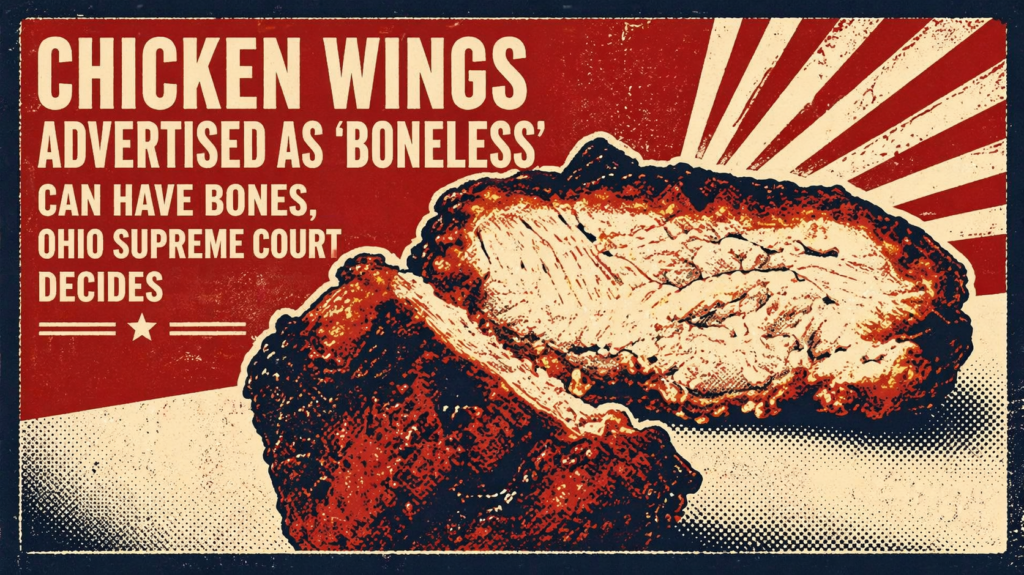
Ohio Supreme Court tells Man Horribly Injured by Chicken Bone Tough Luck
In his Substack post, David Pepper examines what he describes as a troubling example of legal injustice stemming from a high-profile Ohio court case involving a man seriously injured by a bone in a product marketed as “boneless chicken.”
The case centers on Michael Berkheimer, who suffered severe injuries after swallowing a bone while eating what was advertised as “boneless wings” at a restaurant. The injury reportedly caused significant medical complications, including damage to his esophagus. Berkheimer filed a lawsuit against multiple parties in the supply chain, arguing that the labeling was misleading and that consumers reasonably expect “boneless” food to be free of bones.
Pepper’s article highlights how the case progressed through multiple stages of litigation, including appeals, before ultimately reaching the Supreme Court of Ohio. Despite the seriousness of Berkheimer’s injuries, the court ruled against him in a narrow 4–3 decision, concluding that the term “boneless” does not guarantee the absence of bones but instead describes a style of preparation.
Pepper criticizes this reasoning as deeply flawed, arguing that it contradicts common sense and undermines consumer protections. He points out that at every stage—from supplier to restaurant—the product was labeled as “boneless,” with no warning that bones might still be present. According to Pepper, the failure to provide such warnings is central to the injustice of the case.

A key concern raised in the article is the court’s decision to deny the case a jury trial, effectively preventing ordinary citizens from weighing in on whether the labeling was misleading. Pepper frames this as part of a broader erosion of the civil justice system, where judges increasingly decide cases that might traditionally be left to juries. He emphasizes that the appellate court acknowledged the importance of evaluating specific facts but still concluded that a reasonable consumer could anticipate the presence of bones.
Pepper also draws attention to a strongly worded dissent from one of the justices, who criticized the majority opinion as illogical and harmful to the legal system. The dissent argued that the ruling weakens accountability and diminishes the role of juries in resolving disputes. Pepper uses this dissent to reinforce his argument that the case represents a broader problem within the legal system.
Beyond the specifics of the case, Pepper situates the issue within a larger critique of institutional failures. He suggests that the ruling reflects a pattern in which individuals are denied meaningful access to justice, particularly when facing powerful corporate entities. By framing the case as emblematic of systemic issues, he argues that it should concern not only those directly affected but also the public at large.
The article also explores the real-world implications of the decision. Pepper warns that allowing companies to market products in ways that may not align with consumer expectations could lead to further harm and confusion. He argues that clear labeling is essential for consumer safety and that weakening standards could erode trust in businesses and regulatory systems.
Ultimately, Pepper presents the case as more than a dispute over food labeling. Instead, he portrays it as a symbol of deeper legal and societal concerns, including access to justice, corporate accountability, and the role of courts in protecting everyday citizens. His analysis calls for greater scrutiny of judicial decisions and renewed attention to the principles of fairness and common sense in the legal system.

⚖️ Key Legal Outcomes
- Supreme Court of Ohio ruled against the injured plaintiff in a 4–3 decision
- Court held that “boneless” is a cooking style, not a guarantee of no bones
- Plaintiff was denied a jury trial, with the case decided as a matter of law
- Appeals courts previously ruled that consumers could anticipate bones in such food
- Dissenting opinion criticized the ruling as harmful to consumer rights and legal fairness
📊 Why It Matters
- Raises concerns about consumer protection and product labeling standards
- Highlights limitations on jury trials in civil cases
- Reflects broader debates about corporate accountability vs individual rights
- Could influence future cases involving misleading product claims
- Signals potential erosion of common-sense legal interpretations
