
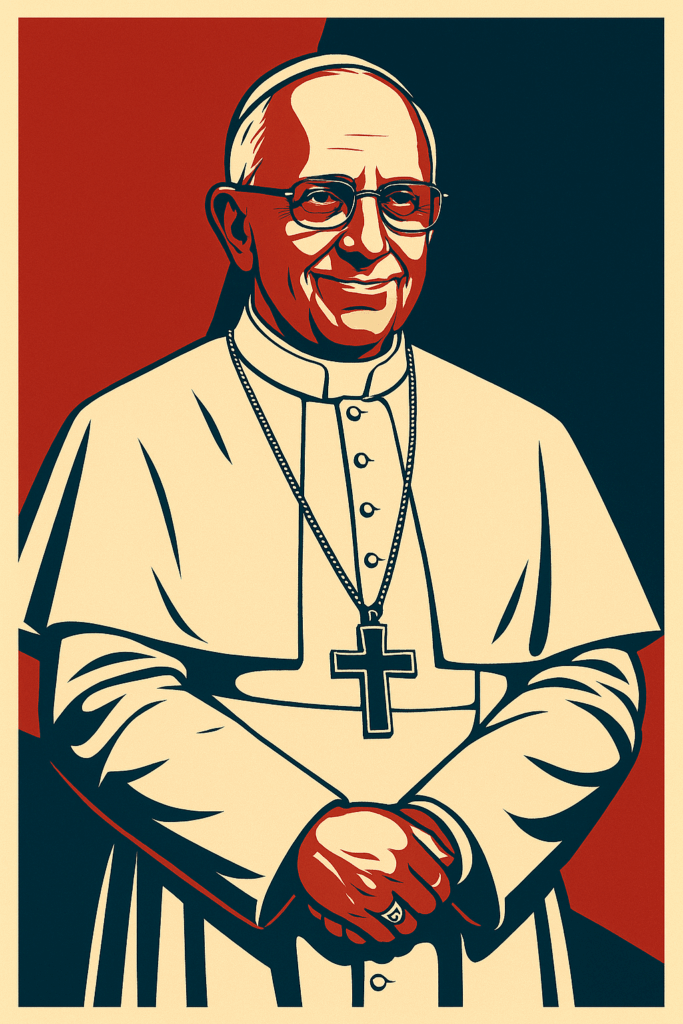
Pope Condemns U.S. Immigration Policies
Highlights:
-
Pope Leo condemns U.S. migrant treatment as “inhuman” and inconsistent with pro-life values
-
He links abortion, immigration, and death penalty under one “consistent life ethic”
-
Remarks follow controversy over Catholic award to Senator Dick Durbin
-
White House rejects Vatican charge, defends Trump’s border policies as lawful
-
Statement marks rare papal intervention in U.S. political debate

A Papal Challenge to U.S. Politics
In his strongest political intervention since becoming the first American-born pope, Pope Leo XIV has condemned U.S. immigration practices under President Donald Trump as “inhuman,” warning that they undermine the Catholic Church’s pro-life mission.
Speaking to reporters at Castel Gandolfo, his summer residence outside Rome, Leo questioned whether those who oppose abortion but endorse harsh immigration or capital punishment policies can rightly call themselves pro-life.
“Someone who says ‘I am against abortion’ but is in agreement with the inhuman treatment of immigrants or with capital punishment—I don’t know if that’s pro-life,” the pope declared. His words have resonated far beyond Catholic circles, cutting to the heart of America’s polarized moral debates.
Expanding the Definition of “Pro-Life”
Leo’s remarks represent a deliberate expansion of Catholic moral teaching into a broader “consistent life ethic.” While the Catholic Church has always opposed abortion, its teachings also emphasize the dignity of migrants, the poor, and the condemned.
By tying abortion, immigration, and capital punishment together, Leo has positioned himself firmly in the tradition of Cardinal Joseph Bernardin’s “seamless garment” approach to life issues, which argued that pro-life commitment must extend from conception to natural death.
This is not a new idea, but Leo’s intervention carries unusual weight because of its timing and context. With Trump seeking to consolidate support from conservative Catholics and evangelicals, the pope’s words directly challenge a core Republican political identity: the idea that opposition to abortion alone defines pro-life morality.
The Durbin Controversy
The pope’s statement also came in response to controversy in Chicago. The city’s archdiocese had announced a lifetime achievement award for Democratic Senator Dick Durbin, praising his decades-long advocacy for immigration reform. But Durbin is also one of the Senate’s most consistent defenders of abortion rights.
Conservative bishops and commentators denounced the award, saying Durbin’s pro-choice record should disqualify him from Catholic honors. Under pressure, Durbin declined the award himself.
Pope Leo used the moment to issue a wider challenge: Catholics should evaluate politicians holistically, considering their contributions to justice, dignity, and human rights—not only their stance on abortion. By doing so, Leo not only defended Durbin’s immigration record but also signaled a broader shift in Vatican priorities.
The White House Response
The pope’s words drew an unusually sharp rebuke from Washington. White House Press Secretary Karoline Leavitt insisted that the Trump administration’s border policies were both lawful and humane, rejecting any claim of inhuman treatment.
“The president has always prioritized security and compassion,” she said, accusing Democrats of hypocrisy for failing to enforce immigration laws in the past.
The White House response underscored how politically sensitive Leo’s remarks are. For a president who has relied heavily on Catholic and evangelical support, papal criticism risks alienating a key moral constituency—even if many U.S. bishops continue to support Trump on abortion.
Papal Voices in American Politics: A Historical Comparison
This is not the first time a pope has clashed with U.S. policy.
-
John Paul II opposed the Iraq War and frequently criticized U.S. militarism, though his anti-communist stance aligned him with American conservatives.
-
Benedict XVI was more reserved but emphasized the dignity of migrants during his 2008 U.S. visit.
-
Francis became an outspoken critic of Trump’s border wall, famously declaring that “a person who thinks only of building walls is not Christian.”
Yet Leo’s case is unique: as the first American-born pontiff, his words strike closer to home. For U.S. Catholics, they cannot be dismissed as foreign moralizing. They represent a rebuke from one of their own.
A Divided U.S. Catholic Church
The controversy highlights the deep rift within American Catholicism. Roughly 50% of U.S. Catholics lean Democratic and 50% Republican, making them a pivotal voting bloc.
-
Conservative bishops and laity emphasize abortion as the defining pro-life issue.
-
Progressive Catholics stress immigration, poverty, and healthcare as equally central to Catholic ethics.
Leo’s intervention effectively strengthens the latter camp. By insisting that immigration policy belongs at the heart of pro-life identity, he challenges conservative Catholics to broaden their moral calculus—and places pressure on the U.S. bishops’ conference, which has often prioritized abortion above all else.
Political and Electoral Implications
Leo’s remarks could ripple into the 2026 U.S. midterms, where immigration and abortion are expected to dominate the political landscape. If Catholic voters begin to reassess their definition of “pro-life,” both parties may find themselves forced to recalibrate.
-
Republicans risk losing Catholic support if they are perceived as inconsistent defenders of life.
-
Democrats could gain ground among Catholics if they highlight immigration and social justice, even while clashing with Church teaching on abortion.
This tension could especially shape battleground states like Pennsylvania, Wisconsin, and Arizona, where Catholic voters remain influential.
A Turning Point for Pope Leo’s Papacy
Until now, Leo has been more cautious than Pope Francis in public political statements. But his remarks on immigration suggest a new willingness to confront global leaders directly.
For the Vatican, this is also a matter of moral consistency. Migration is a global crisis, from the U.S.-Mexico border to the Mediterranean Sea. By linking immigrant dignity with the Church’s pro-life identity, Leo signals that Catholic teaching cannot be compartmentalized or reduced to a single issue.
This approach may not sit comfortably with conservative Catholics—or with the Trump administration. But it underscores Leo’s vision of a church that refuses to separate the unborn from the marginalized, the refugee from the prisoner, the sacredness of birth from the dignity of life’s end.
Why This Story Matters
Pope Leo’s critique is more than a theological nuance; it is a direct challenge to the moral logic of U.S. politics. By expanding the meaning of “pro-life,” he forces both Catholics and non-Catholics alike to confront contradictions between professed values and public policy.
In doing so, he reshapes the conversation about what it means to defend life in the 21st century. Immigration, the death penalty, and abortion are no longer separate battlegrounds—they are threads in a single moral fabric.
For the United States, a nation where Catholic voters are often swing deciders, the pope’s words may carry political consequences as well as spiritual weight.
