
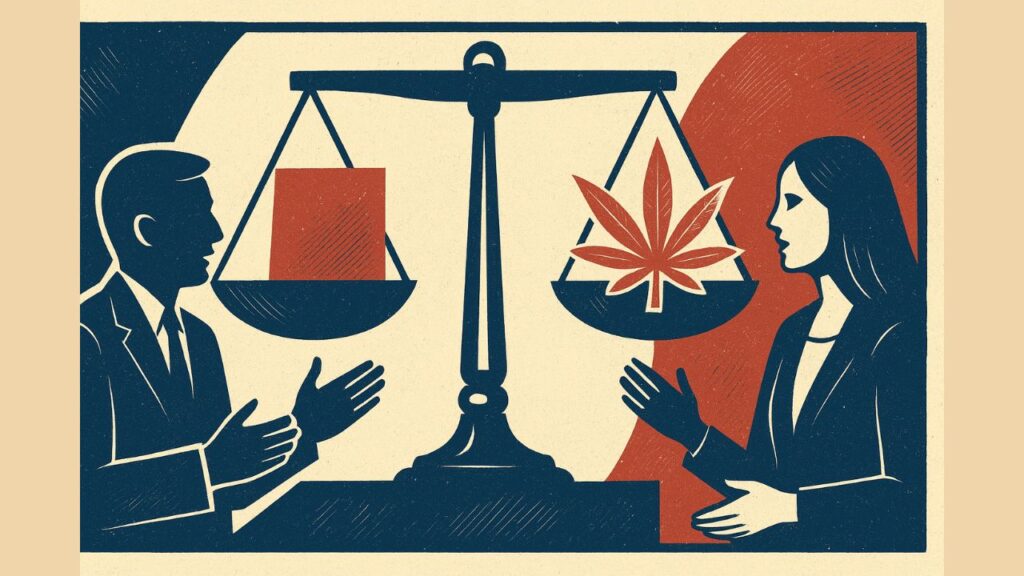
SCOTUS to Review Gun Ban for Drug Users
The Supreme Court of the United States has agreed to hear a pivotal case challenging a long-standing federal statute that prohibits individuals who are “unlawful users of or addicted to any controlled substance” from owning or possessing firearms.
The case arises from a prosecution of Ali Danial Hemani, a dual U.S.-Pakistani citizen whose home was raided in Texas in 2022; agents found a firearm, a quantity of marijuana, and other controlled substances. Hemani was charged under 18 U.S.C. § 922(g)(3) for being an unlawful user of a controlled substance and in possession of a gun.
A three-judge panel of the Fifth U.S. Circuit Court of Appeals struck down the statute as applied in his case, finding it incompatible with the Second Amendment under the standard set by New York State Rifle & Pistol Association v. Bruen (2022) — which held that firearm regulations must be consistent with the nation’s historical tradition of firearm regulation.
The Department of Justice under the Donald Trump administration has appealed that decision, urging the Supreme Court to uphold § 922(g)(3). The government argues that habitual users of illegal drugs pose a heightened risk and that the statute is narrowly tailored — disarming individuals while they are in that category, with the possibility of restoring rights if they cease use.
The Supreme Court’s review signals that the high court will reconsider how broadly the Second Amendment protects firearm possession by persons in specific status-based categories, especially in light of shifting social and legal views on drug use and changing state laws around marijuana. The case is expected to be argued in early 2026, with a decision by June.

Why It Matters
-
Second Amendment boundaries at stake — The outcome will affect how far the right to keep and bear arms extends to persons who use illegal drugs.
-
Impact on hundreds of prosecutions — § 922(g)(3) is one of the more frequently used federal firearm-prohibition statutes; a ruling could affect many existing and future cases.
-
Intersection of drug policy and gun rights — With state laws increasingly legalizing or de-criminalizing marijuana, the federal gun-ban statute is becoming increasingly contested.
-
Historical analogues test refined — The Court has recently emphasized that gun restrictions must align with historical practices; this case forces a decision on whether the ban meets that standard.
-
Public-safety vs civil-rights debate — The decision will influence how regulators, courts and legislators weigh the risk of firearm possession by certain categories of people against constitutional protections.

Key Legal Outcome
-
Supreme Court grant of certiorari — The Court formally accepted review of the statute, meaning § 922(g)(3)’s constitutionality will be decided at the highest level.
-
Focus on “unlawful user” language — The case challenges whether the statute’s broad category of “unlawful user of … controlled substance” is constitutionally valid under the Second Amendment.
-
Potential narrowing of § 922(g)(3) — A decision in favor of Hemani may limit the statute’s application, perhaps only permitting disarmament when use is more than mere status (e.g., active addiction or impairment).
-
Historical-tradition test applied — The Court will decide how closely a modern firearm regulation must resemble historical precedent to pass constitutional muster.
-
Effect on precedent and related statutes — A ruling may have ripple effects on other prohibitions tied to firearm possession (e.g., for those subject to restraining orders, non-violent felons, or mental-health commitments).
