
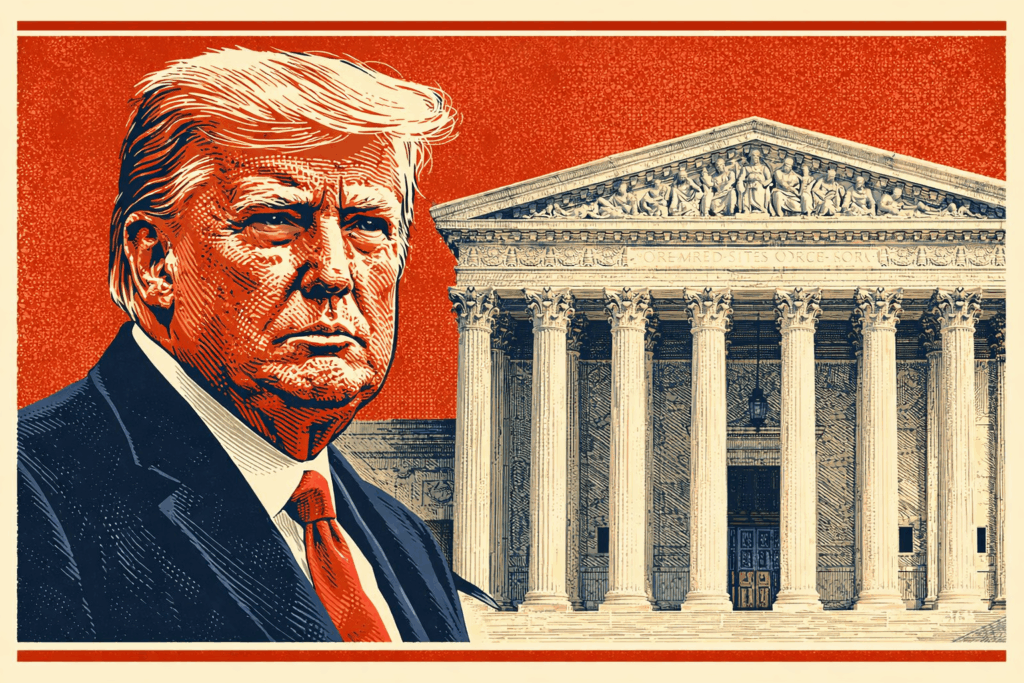
Supreme Court Keeps Ruling in Trump’s Favor, but Doesn’t Say Why
In a sweeping and controversial series of decisions, the U.S. Supreme Court has repeatedly ruled in favor of President Donald Trump’s administration—seven times in the past 10 weeks—without providing any legal explanations. These rulings were issued using what legal scholars call the “emergency docket” or, more critically, the “shadow docket”, a judicial mechanism that allows the Court to make quick decisions without oral arguments or detailed opinions.
On July 14, for example, the Court allowed President Trump to dismantle the Department of Education. The order was a brief four-sentence procedural note that made no mention of why the Court permitted such a drastic move. In contrast, Justice Sonia Sotomayor, joined by Justices Elena Kagan and Ketanji Brown Jackson, issued a 19-page dissent, denouncing the majority’s silence and warning of severe constitutional consequences.
“The majority is either willfully blind to the implications of its ruling or naive,” Sotomayor wrote. “But either way, the threat to our Constitution’s separation of powers is grave.”
The emergency docket, originally intended for urgent decisions that temporarily pause lower court rulings, is now being used to implement sweeping federal actions that reshape major government functions before full legal challenges are considered. These decisions have allowed the Trump administration to:
-
Fire tens of thousands of federal workers
-
Discharge transgender military personnel
-
End protections for migrants from war zones
-
Shift power away from Congress and toward the presidency
Legal experts like Professor Stephen Vladeck (Georgetown University), author of The Shadow Docket, warn that these unexplained rulings have massive real-world effects that bypass the Court’s traditional review process. Instead of a year-long process involving full briefings and arguments, these orders are often decided in just weeks and without justification.
While the conservative majority has embraced this process, critics point to its lack of transparency, consistency, and accountability. Justice Kagan notably criticized the shadow docket in 2021 after the Court let Texas overturn Roe v. Wade at midnight. She wrote that the practice was “unreasoned, inconsistent, and impossible to defend.”
Justice Samuel Alito, defending the practice in a 2021 speech, compared it to emergency medical treatment—prioritizing speed over thoroughness—and pushed back against the “sinister” framing of the term shadow docket. He argued that writing even short opinions requires great care, as each word can have legal ripple effects.

Still, the Court’s silence on landmark issues has stirred concern. In June, for instance, the justices allowed Trump’s administration to deport migrants to third countries without due process—again without explanation. Confusion ensued, and days later, the Court was forced to issue a second ruling to clarify its stance.
Professor Daniel Epps (Washington University) highlighted the dilemma: writing any opinion risks setting unwanted precedent, but failing to write anything breeds mistrust.
“In a highly polarized climate… the justices should feel a heightened obligation to explain their decisions to the public,” Epps said.
Recent rulings, such as the May decision allowing Trump to fire heads of independent agencies, suggest a small shift toward offering minimal justifications. However, the broader trend continues: sweeping, unexplained orders reshaping U.S. governance under a veil of urgency and judicial opacity.

📌 Why It Matters
-
Legal Transparency: The public and lower courts are left without a clear legal foundation for major rulings.
-
Separation of Powers: Silent approvals are shifting authority dramatically from Congress to the executive.
-
Democratic Norms: The Court’s legitimacy depends on its accountability, which is eroded by secrecy.
-
Precedent Confusion: Lower courts struggle with vague or contradictory signals from the Supreme Court.
