
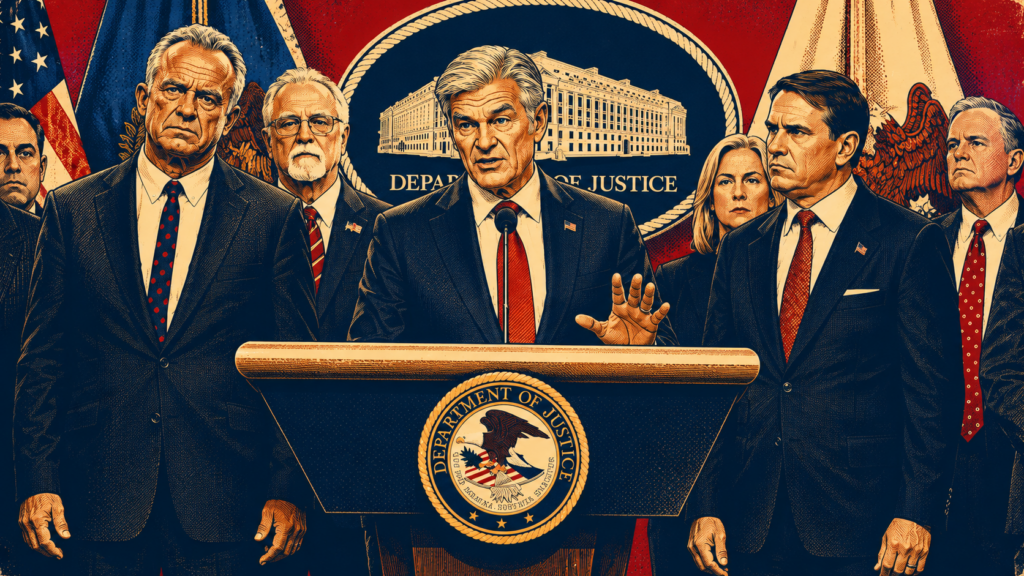
Trump Administration Charges 455 In Massive Healthcare Fraud Crackdown
The Trump administration announced one of the largest healthcare fraud enforcement actions in U.S. history, charging 455 individuals in connection with schemes that allegedly sought to defraud Medicare, Medicaid, and other healthcare programs of more than $6.5 billion. The sweeping nationwide crackdown targeted healthcare executives, physicians, nurses, pharmacists, and business operators accused of submitting fraudulent claims, paying illegal kickbacks, and exploiting vulnerable patients for financial gain.
The charges were unveiled by Acting Attorney General Todd Blanche, who described the operation as the largest coordinated healthcare fraud takedown ever undertaken by federal and state authorities. The investigation spanned 45 states and territories and involved multiple federal agencies, including the Department of Justice, the Department of Health and Human Services, the FBI, the Drug Enforcement Administration, and the Centers for Medicare & Medicaid Services.
According to federal prosecutors, the defendants participated in a wide range of fraudulent activities involving false billing, medically unnecessary procedures, kickback arrangements, opioid-related crimes, hospice fraud, telemedicine fraud, and deceptive healthcare schemes targeting government-funded programs. Authorities alleged that many of the defendants exploited systems designed to provide medical care to elderly, disabled, low-income, and vulnerable Americans.
Among the most significant cases announced was a scheme involving an Arizona-based executive and several medical professionals accused of fraudulently billing Medicare for wound-care products. Prosecutors alleged that the defendants purchased tissue-bank products, relabeled them, dramatically inflated their value, and generated more than $4 billion in fraudulent claims. Authorities said the operation resulted in approximately $2 billion in Medicare payments and financed luxury purchases, including expensive jewelry, high-end vehicles, luxury real estate, and an overseas resort.

Federal officials also highlighted a Texas nurse practitioner accused of orchestrating a separate $906 million healthcare fraud scheme. Prosecutors allege that proceeds from the fraud were used to purchase luxury assets, including exotic cars and international real estate developments. Authorities described the case as an example of how healthcare fraud can enrich perpetrators while diverting resources from programs intended to serve patients in need.
Another case involved a Florida cardiologist accused of conducting medically unnecessary cardiovascular screening tests on college athletes and falsely certifying results without proper review. Prosecutors said the alleged misconduct had serious consequences, including a case involving a student athlete who later died after an undiagnosed heart condition allegedly went unnoticed. Federal officials emphasized that healthcare fraud is not solely a financial crime but can also place patients’ lives at risk.
The Justice Department reported that approximately 90 doctors and other licensed healthcare professionals were among those charged. Officials also announced that more than $127 million in cash, luxury vehicles, cryptocurrency, and other assets had been seized as part of the operation. Investigators used advanced data analytics, artificial intelligence tools, and interagency cooperation to identify suspicious billing patterns and fraudulent activity.
The enforcement action aligns with President Donald Trump’s broader effort to combat government waste, fraud, and abuse. Healthcare fraud has become a central focus of the administration, which has expanded coordination among federal agencies and state attorneys general to identify and prosecute fraud schemes more aggressively. Officials said the operation represents only the beginning of a larger campaign to protect taxpayer dollars and strengthen oversight of public healthcare programs.
Supporters of the crackdown praised the government’s efforts to hold fraudsters accountable and recover stolen funds. They argue that fraud drives up healthcare costs, drains public resources, and undermines trust in programs such as Medicare and Medicaid. Critics, however, have questioned whether some anti-fraud initiatives may be politically motivated, particularly when disputes involve state-administered healthcare programs.
Ultimately, the cases underscore the enormous scale of healthcare fraud in the United States and the government’s increasing reliance on technology, data-sharing, and multi-agency partnerships to combat it. The outcome of these prosecutions could result in substantial financial recoveries and criminal penalties while shaping future enforcement efforts across the healthcare industry.

⚖️ Key Legal Outcomes
- The Justice Department charged 455 individuals in a nationwide healthcare fraud crackdown.
- The cases involve more than $6.5 billion in alleged fraudulent claims submitted to healthcare programs.
- Approximately 90 doctors and licensed medical professionals were among those charged.
- Authorities seized more than $127 million in assets, including cash, luxury vehicles, and property.
- Defendants face allegations involving Medicare fraud, Medicaid fraud, kickbacks, opioid-related crimes, and medically unnecessary treatments.
📌 Why It Matters
- Represents one of the largest healthcare fraud prosecutions in U.S. history.
- Protects taxpayer-funded programs such as Medicare and Medicaid.
- Highlights the financial and human costs of healthcare fraud.
- Demonstrates increased use of AI and data analytics in federal investigations.
- Signals a broader federal effort to combat waste, fraud, and abuse in healthcare programs.
