
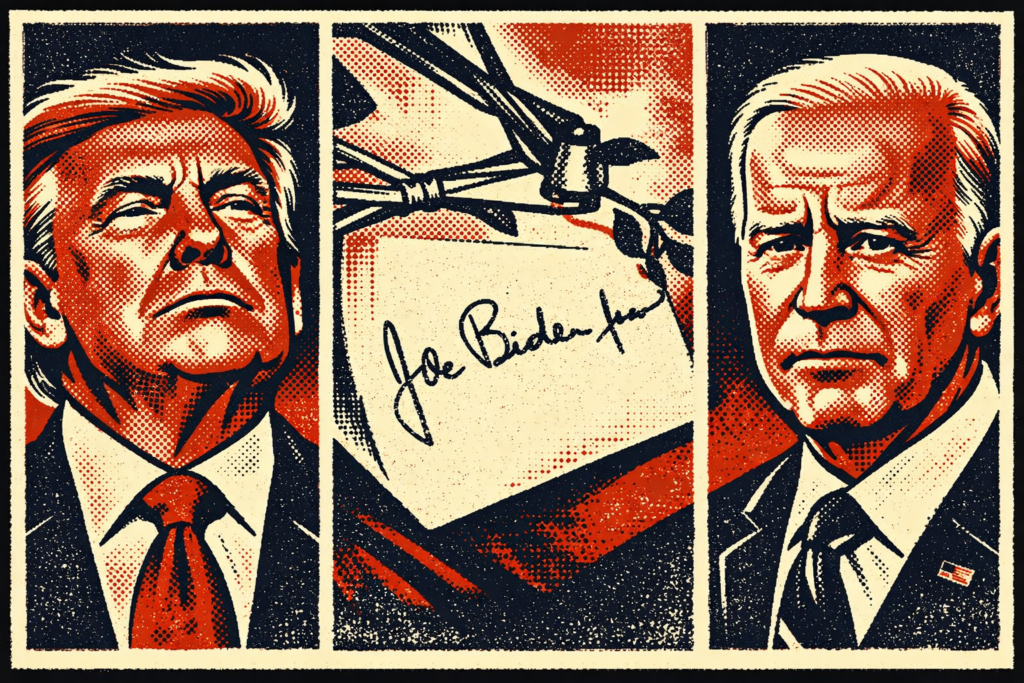
Trump DOJ Finds No Crime in Biden Autopen Use
A report revealed that the U.S. Justice Department under Donald Trump was unable to build a criminal case against former U.S. President Joe Biden related to allegations that Biden improperly used an “autopen” to sign official presidential documents. Investigators examined whether the use of the device could constitute a violation of federal law, but ultimately concluded there was not enough evidence to pursue criminal charges.
The autopen is a mechanical device used to replicate a person’s signature and is commonly employed by government officials, including presidents, to sign large numbers of documents quickly. The device has been used for decades in U.S. government operations, often for routine paperwork, proclamations, or other administrative documents. However, critics and political opponents sometimes question whether its use in certain situations is legally valid, particularly when it comes to binding executive orders or other high-level presidential actions.
The Justice Department reportedly examined whether Biden’s use of the autopen could violate federal statutes regarding presidential authority or document authentication. Some critics argued that if the device were used improperly, it might raise legal concerns about whether the president personally authorized specific documents. However, investigators found no evidence that Biden or his staff had broken the law through the practice.
According to the report, federal prosecutors reviewed the circumstances surrounding the use of the autopen and determined that the practice has historically been accepted within the executive branch. Previous administrations from both major political parties have used similar signature devices for administrative efficiency. Legal experts have long debated the boundaries of this practice, but courts and federal agencies generally consider the use of an autopen lawful if the president authorizes its use.

The inquiry reportedly emerged amid heightened political tensions in Washington, where both parties have increasingly accused each other of misusing government authority. Some Republican lawmakers and conservative commentators had questioned whether certain documents signed by Biden were legally valid if they were not personally signed by the president. The Justice Department’s review sought to determine whether those concerns warranted criminal investigation.
After examining the issue, prosecutors concluded that pursuing criminal charges would not be justified. The investigation did not find evidence that Biden used the autopen in a fraudulent or deceptive manner. Instead, officials determined that the use of the device fell within accepted administrative practices used by many past presidents.
The report also reflects the broader political environment surrounding the Justice Department during Trump’s presidency. Since returning to office, Trump’s administration has emphasized investigations into alleged wrongdoing by political rivals and government officials. Critics argue that some of these investigations are politically motivated, while supporters say they represent legitimate efforts to enforce the law.
In this case, however, the Justice Department reportedly determined that the evidence did not support claims that Biden had committed a crime. The findings illustrate the challenges prosecutors face when evaluating politically sensitive allegations involving high-ranking government officials. Investigators must meet strict legal standards before pursuing charges, particularly when constitutional issues surrounding presidential authority are involved.
Legal analysts say the outcome demonstrates how difficult it is to prove criminal misconduct related to administrative processes inside the executive branch. Because the president has broad authority over executive functions, many internal practices—including signature procedures—fall into a legal gray area unless clear evidence of fraud or abuse exists.
The case also highlights how symbolic political controversies can sometimes trigger formal investigations even when criminal violations are unlikely. The Justice Department’s conclusion that it could not build a criminal case effectively ends the legal aspect of the issue, though the debate over presidential authority and the use of automated signatures may continue in political circles.
Overall, the report underscores the role of prosecutors in determining whether allegations rise to the level of criminal conduct. In this instance, federal investigators concluded that the evidence did not support charges, leaving the matter largely as a political dispute rather than a legal one.

Key Legal Outcomes
-
The Justice Department reviewed whether Joe Biden’s use of an autopen violated federal law.
-
Prosecutors reportedly concluded there was insufficient evidence to bring criminal charges.
-
Investigators determined that the use of an autopen is a long-standing administrative practice in U.S. government.
-
The review did not uncover evidence of fraud or unlawful authorization of documents.
-
As a result, the Justice Department did not pursue a criminal case.
Why This Matters
-
Highlights the legal standards required before prosecutors pursue cases involving political figures.
-
Shows how routine government practices like autopen signatures can become political controversies.
-
Reinforces the broad authority presidents have over executive branch administrative processes.
-
Demonstrates how the Justice Department evaluates allegations involving former presidents.
-
Reflects ongoing political tensions in Washington surrounding investigations of political rivals.
