
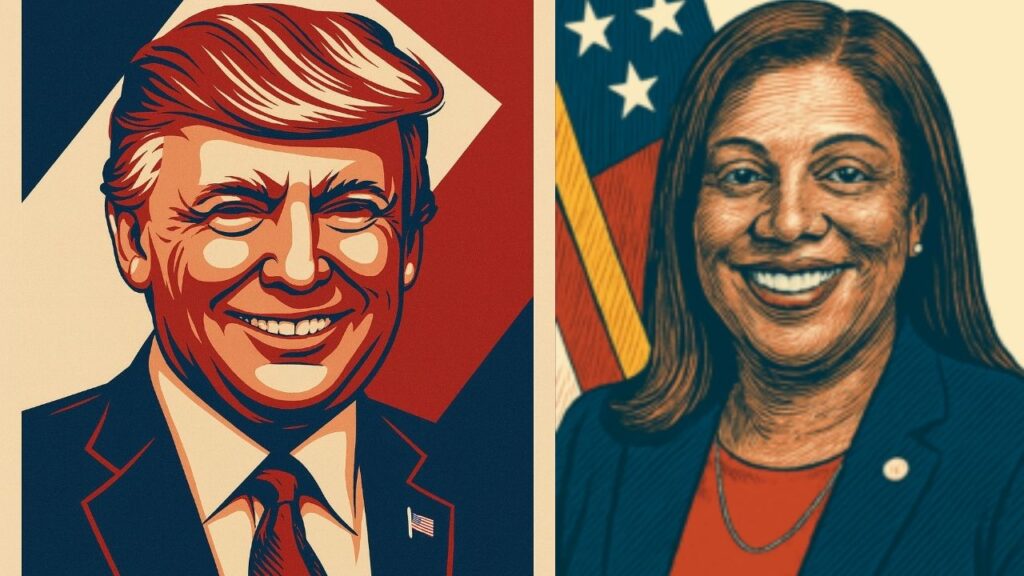
Trump’s Case Against Letitia James Looks a Lot Like the Case She Brought Against Him
In recent weeks, the Donald Trump–Letitia James legal saga has flipped: James, the New York Attorney General who famously brought a multimillion-dollar civil fraud suit against Trump and his businesses, now faces a federal indictment filed under the Trump administration’s Justice Department. Many observers argue the symmetry is striking: what was once legal pressure on Trump is now legal pressure on his prosecutor.
The legal duel between James and Trump
-
In 2022, Letitia James filed a massive civil suit alleging that Trump and the Trump Organization inflated asset values, misled lenders and insurers, and committed a pattern of financial fraud. A New York court initially imposed significant financial penalties.
-
However, in 2025, an appeals court struck down the large penalty — ruling that it was excessive under state law or constitutional standards — though it left intact the finding that Trump had committed some wrongdoing.

-
Now, the DOJ, under Trump’s influence, has indicted James for charges of bank fraud and making false statements to a financial institution, tied to a 2020 mortgage application for a Virginia property. Prosecutors allege that she misrepresented the property as a “secondary residence” when claiming more favorable mortgage terms — even though it was allegedly rented out.
-
The indictment was brought by Lindsey Halligan, a newly appointed U.S. Attorney under Trump, who took over after career prosecutors reportedly questioned the case’s strength. Halligan reportedly proceeded with the grand jury presentation without notifying higher DOJ leadership.
-
Critics immediately drew parallels between James’s prosecution of Trump and Trump’s prosecution of James — both are high-stakes legal matters involving allegations of financial misrepresentation and leverage of powerful positions. In effect, Trump is now turning the tables on a prosecutor who once turned the screws on him.

Tensions, legitimacy, and politics
-
Many legal analysts are skeptical of the strength of the James prosecution. They point to procedural irregularities (e.g. clerical mistakes in the indictment) and the relatively minor financial benefit alleged (tens of thousands of dollars) — a scale that in ordinary circumstances may not merit aggressive federal prosecution.
-
James has responded by denouncing the charges as political retribution for her earlier legal attacks on Trump, casting the DOJ under his influence as weaponized.
-
Democratic leaders and civil rights figures have rallied around James, warning that this marks a dangerous escalation of politicizing the justice system. Some call it a retaliatory strategy: when you sue Trump, Trump sues back — but via prosecutors.
-
The optics are powerful: a prosecutor becomes a defendant; a former subject of legal scrutiny becomes the prosecutor’s attacker. The inversion is feeding a broader narrative about the fragility of legal norms in a highly polarized era.
Why It Matters
-
Rule of law at stake
— When legal power becomes reciprocally wielded, citizens may perceive that justice is selective or retaliatory, not principled. -
Chilling effect on future prosecutors
— If prosecutors fear that suing powerful figures will later make them targets, that may dissuade accountability. -
Perception of DOJ as a political tool
— The symmetry strengthens claims that the Department of Justice is being turned against political enemies. -
Precedent for legal tit-for-tat
— If this pattern continues, we may see escalating legal battles used as political weapons. -
Accountability and immunity questions
— For public officials, the case probes how much legal vulnerability they face when bringing suits or investigations against powerful adversaries.
Key Legal Outcomes & Observations
-
Indictment of James mirrors civil suits against Trump
— Both cases involve allegations of financial misrepresentation and misuse of legal leverage over lending/investment decisions. -
Change in prosecutorial personnel
— Trump reportedly replaced a U.S. Attorney who resisted bringing charges against James with Halligan, who then advanced the case swiftly. AP News+2The Washington Post+2 -
Procedural and clerical errors
— The James indictment includes errors (e.g. listing “Brooklyn, New Jersey”) that amplify concerns about sloppiness or rush. Newsweek -
Weakness of alleged financial benefit
— Experts argue the amount allegedly saved by James is modest, and that typical prosecutorial discretion would not pursue such cases against non-political actors. The Guardian+2The Washington Post+2 -
Defense may argue selective prosecution / retaliation
— James’s legal strategy may involve claiming that she is being singled out because of her past suits against Trump, rather than genuine criminal wrongdoing.
- Source / Publication: This is a summary of coverage from multiple outlets (Reuters, AP, Washington Post, The Guardian, Newsweek).
- Publication timeframe: October 2025 — the coverage crystallizes around October 9–10, 2025.

