
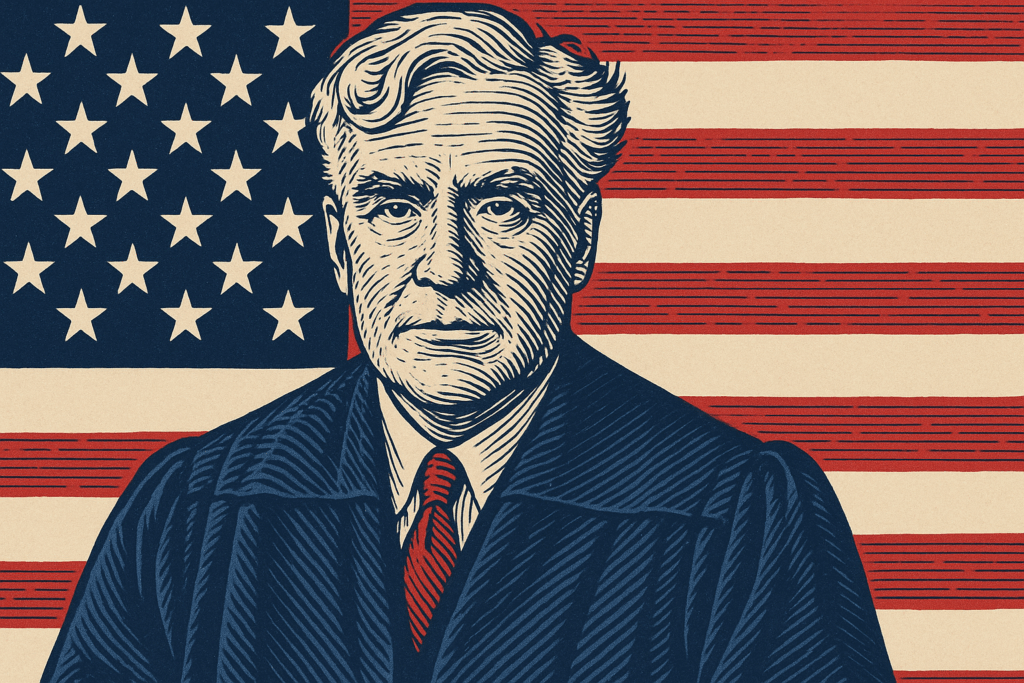
Judge Benjamin N. Cardozo
Name: Benjamin Nathan Cardozo
Historical Role: Associate Justice, Supreme Court of the United States (1932–1938); Judge and Chief Judge, New York Court of Appeals (1917–1932)
Birth–Death: May 24 1870, New York City; July 9 1938, New York City
Party Affiliation: Not publicly confirmed
Career Overview
Benjamin N. Cardozo was a leading American jurist whose opinions shaped twentieth-century common law. After two decades in private appellate practice, he was elected to the New York Supreme Court in 1913 and immediately designated to the New York Court of Appeals. He became a regular member in 1917 and was elected Chief Judge in 1926.
In 1932, President Herbert Hoover appointed Cardozo to the United States Supreme Court. He served until his death in 1938 and was identified with the Court’s liberal bloc, often called the Three Musketeers, along with Justices Louis Brandeis and Harlan Fiske Stone.
“Justice is not to be taken by storm. She is to be wooed by slow advances.”
— The Nature of the Judicial Process (1921)
Education and Early Life
Cardozo entered Columbia College at age 15, graduating Phi Beta Kappa with a B.A. in 1889 and an M.A. in 1890. He attended Columbia Law School, left after two years, and passed the New York bar in 1891, which was permissible at the time.
He was born into New York’s historic Spanish and Portuguese Jewish community. Family circumstances, including his father’s resignation from judicial office in 1868, motivated his devotion to professional integrity and public service.
New York Court of Appeals
As judge and later chief judge, Cardozo authored influential opinions in torts, contracts, corporations, and agency. Representative decisions include:
-
MacPherson v. Buick Motor Co. (1916), expanding manufacturers’ duty of care beyond privity.
-
Wood v. Lucy, Lady Duff-Gordon (1917), recognizing an implied promise as consideration.
-
Jacob & Youngs v. Kent (1921), explaining substantial performance and contract damages.
-
Meinhard v. Salmon (1928), articulating the high fiduciary duty among business partners.
-
Palsgraf v. Long Island Railroad Co. (1928), refining proximate cause and foreseeability.
-
Ultramares v. Touche (1931), limiting auditors’ negligence liability to avoid indeterminate exposure.
He also addressed hospital liability, the rescue doctrine, statutory breaches as negligence, and the corporate veil.
United States Supreme Court
On the Supreme Court, Cardozo wrote major opinions involving constitutional structure and federal power, including:
-
Nixon v. Condon (1932), invalidating a whites-only party primary.
-
Steward Machine Co. v. Davis (1937) and Helvering v. Davis (1937), sustaining key parts of the Social Security framework.
He joined or authored notable writings in Commerce Clause and administrative power cases during the New Deal era.
Publications
Cardozo’s lectures and essays remain staples of judicial thought:
-
The Nature of the Judicial Process (1921)
-
The Growth of the Law (1924)
-
The Paradoxes of Legal Science (1928)
-
Law and Literature and Other Essays and Addresses (1931)
These works, concise and philosophical, explored judging, precedent, and legal evolution.
Public Image and Philosophy
Cardozo was celebrated for lucid prose, careful reasoning, and pragmatic common-law craftsmanship. He balanced stability with incremental change, explaining how social needs and experience inform doctrine while respecting precedent. He received numerous honorary degrees and broad bipartisan support for his federal appointment.
Personal Life
Cardozo was devoted to his family, especially his older sister Nell, and never married. He identified culturally with his Jewish heritage, although he did not practice religion as an adult. He died in 1938 following illness and is buried in Queens, New York.
Fast Facts
-
Passed the New York bar in 1891 after two years of law school
-
Elected to New York’s highest court in 1917, elected Chief Judge in 1926
-
Appointed to the U.S. Supreme Court in 1932, served until 1938
-
Member of the Court’s liberal bloc during the New Deal
-
Authored foundational opinions in tort and contract law
-
Delivered Yale’s Storrs Lectures, later published as The Nature of the Judicial Process
-
Received honorary LL.D. degrees from leading universities
-
Known for clear, elegant judicial writing and cautious legal reform
- Cardozo Law School, Founded in 1976

