
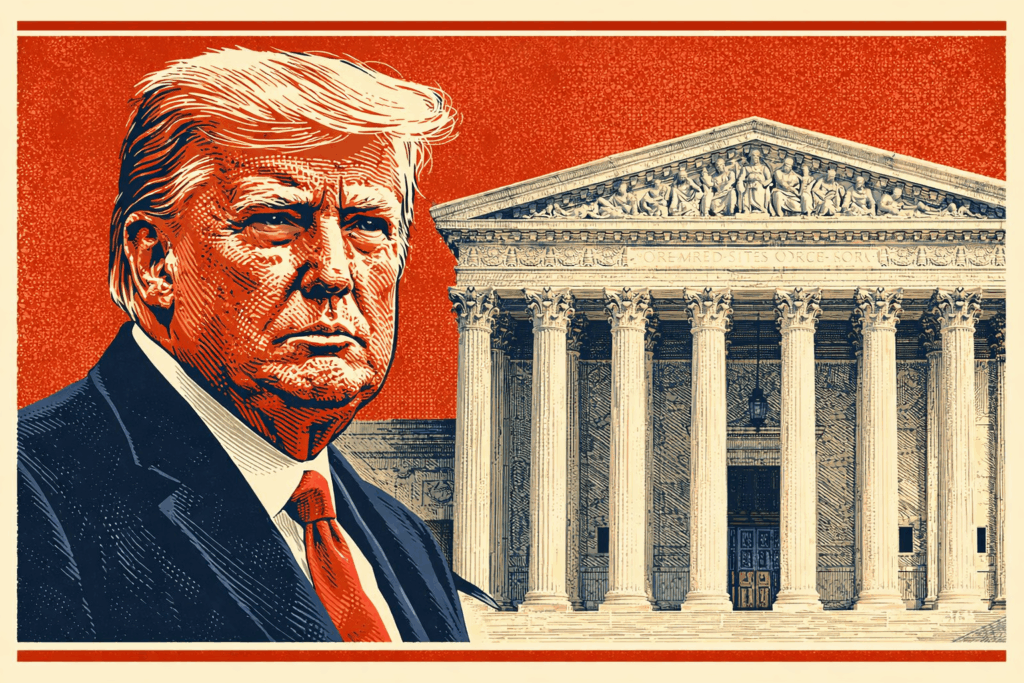
Trump Rages Over Supreme Court Loss
President Donald J. Trump, has been publicly reacting with visible frustration and alarm to the possibility that the U.S. Supreme Court may strike down a major tariff program enacted during his presidency. The case has moved to the high court after lower courts questioned the legal authority of Trump’s administration to impose sweeping tariffs.
President Trump has taken to his social media platform Truth Social with increasingly urgent posts, warning that a Supreme Court defeat would cause significant financial harm to the United States and accusing the press of suppressing favorable coverage of his tariffs. In one post, he claimed — without evidence — that the tariffs have generated more than $600 billion in revenue for the federal government, and suggested that media outlets refuse to report this because of political bias.
The tariffs in question were imposed using an unconventional legal strategy: rather than invoking standard trade statutes, the Trump administration relied on the International Emergency Economic Powers Act (IEEPA), a Cold War–era law granting broad executive authority in declared emergencies. A federal appeals court previously ruled that using IEEPA to justify sweeping tariffs exceeded the president’s lawful authority, concluding that the executive cannot sidestep Congress’s role in trade and taxation through a broadly defined national-security rationale.

During Supreme Court oral arguments in November 2025, even conservative justices who often favor executive authority appeared skeptical of the legal justification presented. Justices Amy Coney Barrett, Neil Gorsuch, and Chief Justice John Roberts pressed the administration’s lawyers on whether the president’s emergency powers could legitimately be used to implement widespread economic policy without congressional approval.
President Trump has emphasized in social media posts that overturning the tariffs could lead to an “unwind” of revenue collections — potentially requiring refunds of billions — although experts dispute the accuracy of these claims. Analysts note that if the Supreme Court rules against the administration, it could not only challenge the legality of the tariffs but also impact ongoing trade relationships with foreign partners who were subject to retaliatory tariffs during Trump’s earlier term.
This case serves as a critical test of the limits of presidential power, particularly regarding the use of national-security justifications to enact broad economic policies. The Supreme Court’s ruling will have implications not only for President Trump’s current trade agenda but also for future administrations seeking to leverage emergency powers in economic or foreign policy decisions.
Trump’s strong public reaction reflects both the political and personal stakes of the outcome. The tariffs have been a centerpiece of his economic strategy and messaging to supporters, and a Supreme Court ruling against the administration would be a substantial legal and political setback. Observers are closely watching the case, which could set lasting precedent on executive authority, separation of powers, and the judicial oversight of national-security actions.

Why It Matters
-
Limits presidential authority: Clarifies boundaries on executive power over trade and national-security actions.
-
Economic impact: If struck down, the legality of billions in tariffs already collected could be challenged.
-
Judicial precedent: Influences how courts evaluate national-security justifications for economic policies.
-
Political implications: A ruling against Trump affects his economic messaging and policy credibility.
-
Public discourse: Highlights the role of social media in shaping public perception of legal matters.
⚖️ Key Legal Outcomes
-
Supreme Court review of the legality of Trump’s tariff program under IEEPA.
-
Lower appeals court ruled Trump exceeded executive authority by using emergency powers for tariffs.
-
Conservative justices expressed skepticism about the administration’s legal rationale.
-
A ruling against the administration could force refunds or adjustments for previously collected tariffs.
-
Sets a judicial precedent on presidential authority vs. congressional control over trade.
