
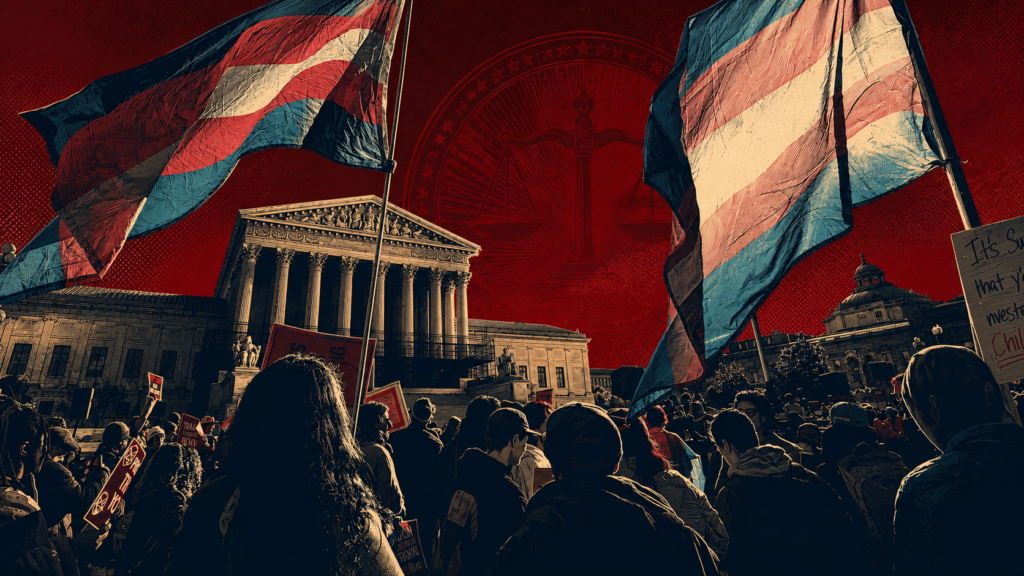
Supreme Court Becomes Tougher Venue For Transgender Rights Cases
Recent decisions by the U.S. Supreme Court signal an increasingly difficult legal landscape for transgender Americans, as the Court’s conservative majority continues to uphold laws and policies restricting transgender rights. A series of rulings over the past two terms has narrowed legal protections in areas including school sports, gender-affirming healthcare, military service, and government recognition, marking a notable shift from earlier decades when the Court expanded LGBTQ rights.
The latest example came this week when the Supreme Court upheld laws in West Virginia and Idaho barring transgender girls from competing on girls’ and women’s school sports teams. In a decision split 6-3 along ideological lines, the Court concluded that the state laws do not violate either the Equal Protection Clause of the U.S. Constitution or Title IX, the federal law prohibiting sex discrimination in education. Justice Brett Kavanaugh, writing for the majority, said states may separate athletic teams based on biological sex in pursuit of fairness and safety in women’s sports.
The sports ruling follows another major decision issued earlier this year in which the Court upheld Tennessee’s ban on gender-affirming medical care for transgender minors. That ruling rejected constitutional challenges to state restrictions on treatments such as puberty blockers and hormone therapy for minors, giving states broad authority to regulate such care. Together, the decisions reinforce the Court’s willingness to defer to state legislatures on transgender-related policies.
The Supreme Court has also permitted the Trump administration to enforce restrictions on transgender military service while litigation continues, allowing policies that limit or prohibit many transgender individuals from serving in the U.S. Armed Forces. In addition, the Court has declined to block federal policies affecting passport gender markers and other executive actions involving transgender rights. These rulings reflect a broader judicial trend favoring government authority over challenges brought by transgender plaintiffs.

Legal scholars say the current Court differs sharply from the one that produced landmark LGBTQ-rights decisions over the past three decades. Earlier Courts recognized constitutional protections in cases striking down laws criminalizing same-sex relationships and recognizing same-sex marriage. In 2020, the Court also ruled that federal employment discrimination law protects gay and transgender workers from workplace discrimination. However, today’s Court has shown far greater skepticism toward extending constitutional protections in cases involving transgender rights.
Despite the recent setbacks, advocates note that the Court has not declared transgender people outside the protection of the Constitution or federal civil rights laws. Instead, many of the decisions have been narrowly tailored to specific legal questions, leaving open the possibility of future challenges involving employment, housing, healthcare, education, and other forms of discrimination. Civil rights organizations argue that the legal fight is shifting to state legislatures, lower federal courts, and Congress.
One closely watched dispute is already on the Supreme Court’s horizon. The justices are expected to consider whether parents may challenge a Washington state law that allows runaway transgender minors to receive shelter and certain services without immediately notifying their parents. The case could further define the balance between parental rights, state authority, and protections for transgender youth.
Supporters of the recent rulings argue that states should retain authority to regulate sensitive issues involving youth sports, medical treatment, and education. They contend that elected lawmakers—not federal judges—should make policy decisions in areas where scientific, medical, and social debates remain ongoing. Opponents, meanwhile, warn that the decisions may encourage additional restrictions targeting transgender people and make it increasingly difficult to challenge those laws successfully in court.
The Court’s recent term underscores how dramatically the legal environment has changed. While transgender Americans continue to enjoy important protections in some areas—particularly employment discrimination under existing federal precedent—the Supreme Court has repeatedly upheld government actions limiting transgender rights in several high-profile disputes. As additional cases move through the courts, the justices are likely to remain at the center of one of the nation’s most closely watched constitutional debates.

⚖️ Key Legal Outcomes
- The Supreme Court upheld Idaho and West Virginia laws restricting transgender girls from participating in girls’ school sports.
- The Court has recently upheld state restrictions on gender-affirming care for minors.
- The justices have allowed restrictions on transgender military service to remain in effect during litigation.
- Recent rulings generally defer to state and federal governments on transgender-related policies.
- Additional transgender rights cases are expected to reach the Supreme Court.
📌 Why It Matters
- Highlights the Supreme Court’s increasingly conservative approach to transgender rights.
- May encourage additional state laws regulating transgender participation in sports and healthcare.
- Shapes future constitutional challenges involving LGBTQ rights.
- Leaves many transgender-rights disputes to legislatures rather than courts.
- Signals that the legal landscape will continue evolving through future Supreme Court cases.
