
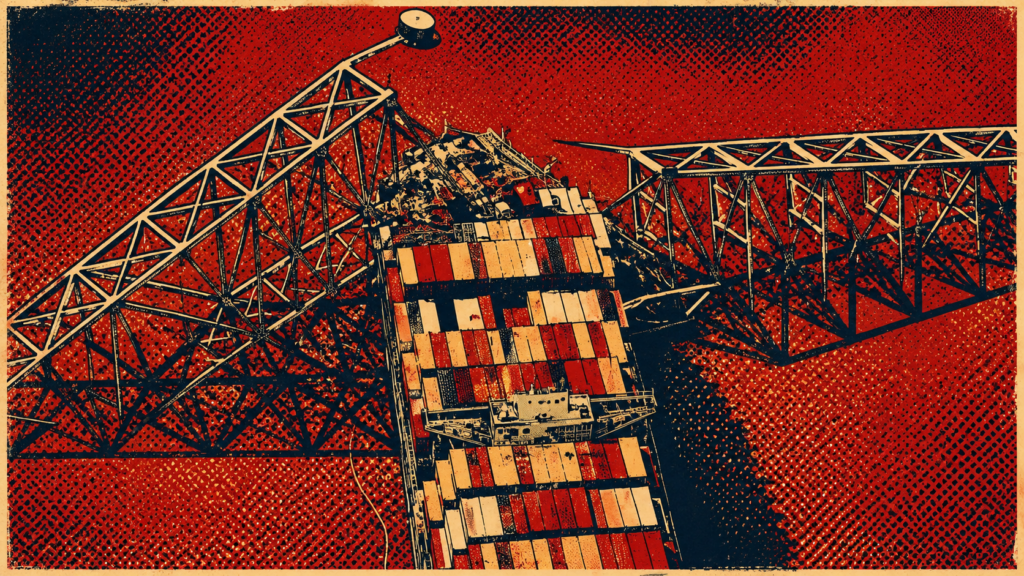
Criminal Case Emerges From Baltimore Infrastructure Collapse
Federal prosecutors have filed criminal charges against two companies and one individual in connection with the catastrophic 2024 collapse of Baltimore’s Francis Scott Key Bridge, marking one of the most significant infrastructure-related criminal cases in recent U.S. history.
The indictment, announced by the U.S. Department of Justice, alleges that serious negligence and safety failures contributed to the disaster that caused multiple deaths, disrupted major shipping operations, and inflicted billions of dollars in economic damage. The collapse occurred after a cargo vessel struck a support pillar of the bridge, causing a massive structural failure that sent sections of the bridge into the Patapsco River.
Additionally, the legal fallout from the disaster has expanded beyond the federal criminal case. Separately, Anthony Brown announced that the state of Maryland reached a final $2.25 billion settlement with Grace Ocean Private Limited and Synergy Marine Pte Ltd, the owner and operator of the cargo ship Dali, ahead of a scheduled June 1 trial date. The settlement resolves Maryland’s claims against the vessel’s ownership and management entities related to the bridge collapse and resulting economic damages. However, the agreement does not resolve the state’s separate claims against Hyundai Heavy Industries, the company that built the Dali. Maryland officials continue to pursue allegations tied to the vessel’s design, construction, and potential engineering defects that may have contributed to the catastrophe.
According to prosecutors, the charges target the ship’s operator, a maritime maintenance contractor, and an engineer responsible for overseeing critical safety systems aboard the vessel. Federal authorities allege the defendants ignored repeated warnings about electrical and mechanical problems affecting the ship prior to the collision.
Investigators claim that the vessel experienced ongoing power and propulsion issues in the months leading up to the crash. Internal reports and maintenance records allegedly showed unresolved defects involving backup generators, steering systems, and electrical distribution components. Prosecutors contend these failures were either inadequately repaired or improperly documented, allowing the vessel to continue operating despite safety concerns.
The indictment accuses the companies and the engineer of conspiracy, making false statements to federal regulators, and criminal negligence tied to maritime safety obligations. Authorities allege that maintenance logs were falsified and that key information about the ship’s operational risks was withheld from inspectors and investigators.
The Francis Scott Key Bridge collapse became a national tragedy in March 2024 when the cargo ship lost power shortly before impact. Several construction workers performing overnight repairs on the bridge were killed after sections of the structure plunged into the river. The collapse also shut down one of the nation’s busiest shipping routes, significantly disrupting East Coast commerce and supply chains.
Federal prosecutors emphasized that the case is not simply about an accident, but about preventable failures and alleged misconduct. Justice Department officials argued that companies entrusted with public safety responsibilities must be held accountable when negligence leads to catastrophic consequences.

The criminal case follows months of investigations conducted by the FBI, the National Transportation Safety Board (NTSB), and maritime regulators. Preliminary NTSB findings had already pointed to power system failures aboard the vessel shortly before the collision. However, the criminal indictment goes further by alleging that those failures were known risks that were concealed or ignored.
Legal experts note that criminal prosecutions related to infrastructure disasters are relatively rare and often difficult to prove. Prosecutors must demonstrate not only negligence, but criminal intent or reckless disregard for safety standards. The inclusion of conspiracy and false statement charges suggests investigators believe there was deliberate misconduct rather than isolated operational mistakes.
The companies involved have denied wrongdoing and are expected to challenge the allegations aggressively in court. Defense attorneys argue that the collapse was a tragic maritime accident caused by a complex chain of events, not criminal conduct. They also contend that investigators may be unfairly assigning blame before the full technical analysis is complete.
Beyond the courtroom, the case has broader implications for infrastructure safety and corporate accountability. The disaster exposed vulnerabilities in aging transportation infrastructure and intensified scrutiny of shipping industry safety standards. It also renewed calls for stronger oversight of commercial vessels operating near critical infrastructure.
The prosecution may also influence future regulatory reforms involving bridge protection systems, vessel inspection requirements, and emergency response protocols. Lawmakers and transportation officials have already discussed proposals aimed at preventing similar incidents in major ports across the United States.
Ultimately, the case represents a major test of corporate criminal liability in the context of infrastructure disasters. If prosecutors succeed, the proceedings could establish an important precedent for holding companies and executives criminally responsible for failures that lead to large-scale public harm.

⚖️ Key Legal Outcomes
- U.S. Department of Justice indicted two companies and one engineer over the bridge collapse.
- Charges include criminal negligence, conspiracy, and false statements.
- Prosecutors allege defendants ignored known electrical and mechanical failures.
- Case focuses on alleged falsified maintenance and safety records.
- Defendants deny wrongdoing and are expected to contest the charges in court.
📌 Why It Matters
- One of the most significant infrastructure-related criminal cases in years.
- Raises questions about corporate accountability in public safety disasters.
- Could reshape standards for maritime maintenance and vessel oversight.
- Highlights vulnerabilities involving critical U.S. transportation infrastructure.
- May influence future reforms in bridge protection and shipping regulations.
