
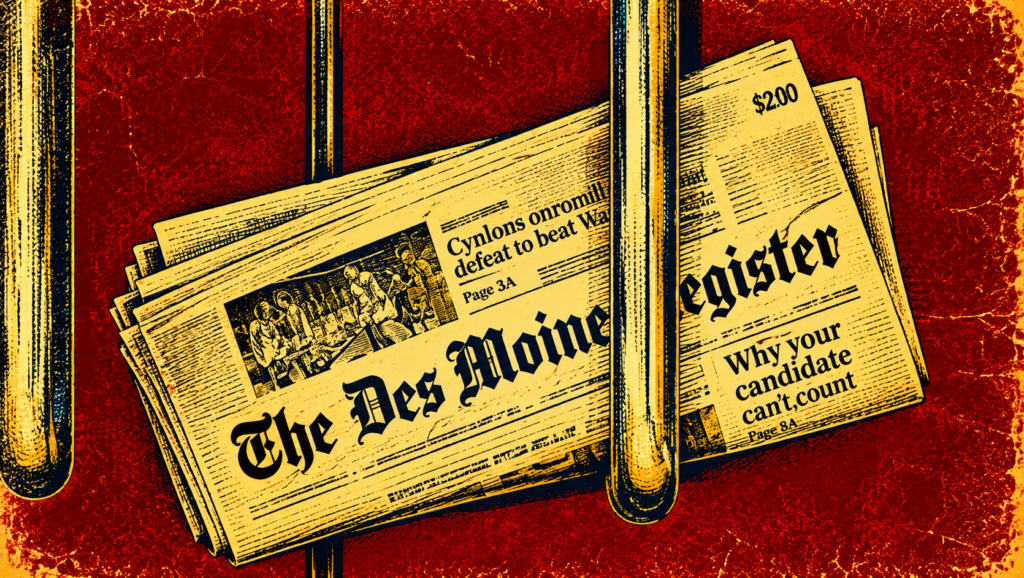
Judge Dismisses Trump Lawsuit Over Iowa Poll
An Iowa state judge has dismissed a lawsuit brought by President Donald Trump against the Des Moines Register, its parent company and longtime pollster J. Ann Selzer, concluding that the challenged election poll and related reporting are protected by the First Amendment. The ruling, issued September 23, 2026, ends the case at the trial-court level, although Trump’s legal team has indicated that it plans to appeal.
The lawsuit arose from an Iowa Poll published shortly before the 2024 presidential election. The poll, released on November 2, 2024, showed then-Democratic presidential candidate Kamala Harris leading Trump by three percentage points in Iowa. Trump subsequently won Iowa by more than 13 percentage points. Trump argued that the poll was not simply inaccurate but had been intentionally manipulated and therefore amounted to fraud under Iowa law.
Trump filed the lawsuit in December 2024, naming Selzer, the newspaper and its parent company as defendants. The case included claims under Iowa’s consumer-fraud laws. Trump and the other plaintiffs argued that the publication of the poll had misled the public and sought to impose legal responsibility for what they characterized as an improperly conducted or intentionally distorted poll. The defendants disputed those allegations and argued that political polling and related discussion constitute protected speech.
Judge Scott J. Beattie rejected the lawsuit after considering the parties’ arguments. A central part of his decision was the First Amendment, which protects freedom of speech and freedom of the press. The judge determined that election polling and predictions about political contests fall within a highly protected category of political expression.
The judge also addressed the fundamental problem of treating an incorrect poll as fraudulent conduct. Political polls attempt to measure public opinion at a particular moment using statistical and methodological assumptions, and they cannot guarantee an election result. The judge said that predictions based on the interpretation of objective data are not necessarily statements of fact that can be proven true or false in the same way as ordinary commercial representations.
Importantly, the court’s reasoning went further than simply accepting the defendants’ account of how the poll was conducted. According to the ruling, even if the court assumed for purposes of the legal analysis that the allegations made by Trump’s side were true—including allegations that the poll had been intentionally skewed—the claims still did not satisfy the requirements of the relevant fraud and consumer-deception laws.
That distinction is legally significant. The dismissal did not constitute a factual finding that every allegation concerning the poll was false. Instead, the court concluded that the legal claims could not proceed because the speech at issue received constitutional protection and the asserted conduct did not fit the applicable statutory causes of action. The ruling therefore focused heavily on whether the lawsuit could legally be maintained rather than conducting a trial over the accuracy or methodology of the poll.
The decision also considered the potential effect of allowing such a case to proceed. Judge Beattie said permitting the lawsuit could discourage people from reporting on and debating public affairs. That concern reflects the constitutional importance of protecting political discussion, particularly during elections, when voters routinely encounter polling data, forecasts and competing interpretations of political trends.

The case also comes against a changing legal backdrop in Iowa. The state enacted an anti-SLAPP law in 2025 designed to provide additional protection against lawsuits targeting speech and public participation. The law became relevant to the broader discussion surrounding the case, although the judge’s dismissal was principally grounded in the First Amendment and the failure of the plaintiffs’ statutory claims.
Selzer had acknowledged that the poll was substantially wrong compared with the eventual Iowa result. She maintained that the poll followed the methodology she had previously used and emphasized that election polling cannot guarantee an election outcome. After the 2024 election, she left political polling.
Trump’s legal team has said it intends to appeal the dismissal. That means the ruling may not be the final judicial word on the dispute. An appellate court could review whether the trial judge correctly applied the First Amendment and Iowa law to the claims. Until any appeal is resolved, the September 23 ruling remains the operative decision dismissing the case.
The lawsuit is part of a broader series of legal disputes involving Trump and media organizations, but this particular case is focused on the publication of an election poll and whether such polling can give rise to consumer-fraud liability. The decision is consequently relevant beyond the parties themselves because it addresses the boundary between political expression and state-law claims alleging fraud or deception.
The ruling also highlights an important distinction between being wrong and being legally liable. A poll can differ substantially from an eventual election result without that difference necessarily establishing fraud. For a fraud-based legal claim to succeed, additional legal requirements must be met. Judge Beattie concluded that those requirements were not satisfied here, even under the assumptions favorable to the plaintiffs used in analyzing the case.
For Trump, the immediate result is that the lawsuit has been dismissed at the Iowa trial-court level. For Selzer and the other defendants, the dismissal removes the current case from the trial court unless an appeal changes the outcome. For the broader legal system, the ruling reinforces the constitutional protection afforded to political polling and election-related expression while leaving open the possibility of appellate review.
The case therefore centers on a broader legal question: how far can state fraud laws reach when applied to political speech and election polling? The Iowa judge’s answer in this case was that the First Amendment protection was too strong and the plaintiffs’ statutory theories did not provide a sufficient legal basis to continue the lawsuit.

Key Legal Outcome
- The Iowa lawsuit was dismissed: Judge Scott J. Beattie dismissed Trump’s case against the newspaper, its parent company and pollster J. Ann Selzer.
- First Amendment protection was central: The judge determined that the election poll constituted highly protected political speech.
- Fraud claims failed legally: The court concluded that the allegations did not satisfy the requirements of Iowa’s fraud and consumer-deception laws.
- The poll’s inaccuracy did not establish fraud: The judge emphasized the inherent uncertainty of polling and predictions about future election results.
- An appeal is possible: Trump’s legal team has indicated that it intends to challenge the dismissal in an appellate court.
Why It Matters
- Press freedom: The ruling addresses the constitutional protection afforded to election-related reporting and political expression.
- Polling liability: It distinguishes an inaccurate election prediction from conduct that legally constitutes fraud.
- First Amendment: The decision demonstrates how constitutional free-speech protections can affect state-law claims involving political communication.
- Election coverage: The case could influence how courts approach future disputes involving polling, forecasts and election reporting.
- Appeal implications: An appellate review could provide further clarification about the boundaries between political speech and fraud claims.
