
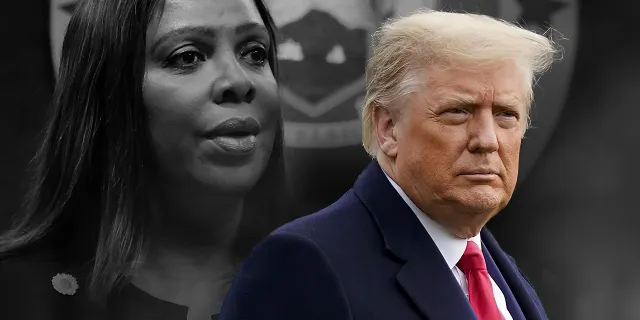
Trump says US attorney who didn’t charge political enemy Letitia James with mortgage fraud should be fired
President Donald Trump is reportedly moving to fire Erik Siebert, the U.S. Attorney for the Eastern District of Virginia, after Siebert’s office declined to bring criminal charges against New York Attorney General Letitia James. The case involved allegations that James misrepresented her primary residence to obtain favorable mortgage terms. However, prosecutors found the evidence too weak to prove fraud, concluding that the disputed power of attorney form had not influenced the loan approval and that other documents did not misstate James’s residency. Siebert’s refusal to indict angered White House officials, who pressured him to proceed despite the lack of evidence.
Siebert, nominated by Trump and supported by both Democratic senators from Virginia, has overseen key federal prosecutions involving national security, corruption, and violent crime. His potential removal raises concerns about instability at a major U.S. Attorney’s office. If dismissed, his deputy, Maya D. Song, would likely step in, though reports suggest the administration might also attempt to bypass her to install a more politically compliant figure.
The attempted ouster comes amid allegations that Trump is weaponizing the Department of Justice to pursue political enemies. Letitia James, who previously led the civil fraud case against Trump in New York, has long been a target of the former president’s attacks. Legal experts warn that the push to punish a prosecutor for refusing to charge a political rival sets a dangerous precedent, eroding the independence of federal law enforcement.

Beyond the individual case, the episode highlights the tension between prosecutorial discretion and political interference. While prosecutors must assess whether evidence meets the legal threshold, political actors may seek outcomes that serve partisan goals. The growing spotlight on Siebert’s situation underscores fears that the Justice Department could be reshaped into a political tool, with long-term consequences for democratic institutions and public trust in impartial justice.
Overall, the controversy illustrates how fragile the boundary can be between law and politics in high-stakes investigations. Trump’s willingness to remove prosecutors who resist pressure raises broader questions about the balance of power, the durability of institutional safeguards, and whether the Justice Department can maintain its independence in a climate of escalating partisan conflict.

Why it matters
-
DOJ independence: Undermines the principle that federal prosecutors must act based on law and evidence, not political pressure.
-
Weaponization risk: Suggests Trump is using prosecutorial power to target political opponents like Letitia James.
-
Institutional stability: Firing a U.S. Attorney mid-case could destabilize one of the most important federal offices.
-
Precedent setting: Could normalize punishing prosecutors for refusing to pursue politically motivated charges.
-
Public trust: Raises doubts about whether the justice system can remain impartial amid partisan conflict.
Key legal outcomes
-
Siebert’s office determined evidence against Letitia James was insufficient to prove mortgage fraud.
-
Trump administration officials pressured Siebert to bring charges regardless.
-
Plans are underway to remove Siebert from his post.
-
Deputy U.S. Attorney Maya D. Song could temporarily take over but may also face replacement.
-
The case fuels broader legal debate about prosecutorial discretion and political interference.
Publication date & Live Link
- Publication date: September 19, 2025
- Live link: Trump poised to fire U.S. attorney who resisted charging Letitia James – CNN
