
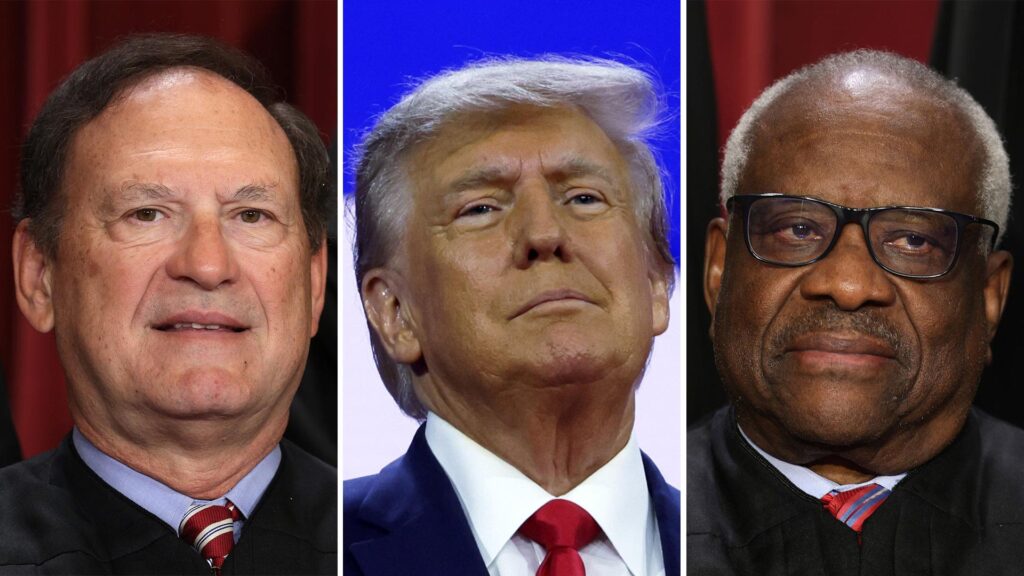
Trump’s Conventional Court Picks May Encourage Alito & Thomas to Step Down
As President Trump continues to nominate judges across the federal judiciary, his selections—more traditional than earlier, more controversial picks—have sparked speculation that longtime Supreme Court justices Samuel Alito and Clarence Thomas might feel more comfortable retiring. Unlike the earlier nominee Emil Bove—who had drawn ire even from conservative commentators—recent nominees like Rebecca Taibleson and Eric Tung signal a return to establishment-style appointments, offering reassurance to those contemplating stepping down.
In his second term, Trump has adopted a more hands-on approach in vetting candidates, personally touching base with some of them. This deliberate involvement suggests a concerted effort to maintain a conservative ideological legacy while easing concerns about the quality and ideological consistency of future appointees.

Judges—even those on the highest court—typically time their retirements to align with favorable political conditions. Given that Trump’s nominees are viewed as more conventional and like-minded, Alito and Thomas might judge this an opportune moment to depart, knowing their replacements would likely uphold the Court’s conservative orientation.
Although Trump publicly distanced from the Federalist Society’s role in the vetting process, the organization’s influence remains pervasive. Many of the potential future nominees—including federal appellate judges Andrew Oldham, James Ho, and Neomi Rao—come from within the Society’s ecosystem, reinforcing its longstanding impact in shaping the conservative judicial pipeline.
Thus far, judicial retirements in Trump’s second term have been limited. However, the shift toward more moderate conservative picks may change that calculation. If Alito, currently in his mid-70s, or Thomas, in his late 70s, choose to retire, it risks giving Trump the opportunity to further entrench his ideological imprint—a development with significant implications for future rulings in reproductive rights, federal power, and executive authority.

Key Legal Outcomes
-
Smooth Confirmations Likely
More conventional judicial nominees reduce controversy and streamline the confirmation process. -
Strategic Openings
Alito and Thomas may be more likely to retire, enabling Trump to influence long-term judicial balance. -
Reinforced Conservative Pipeline
Continuity with Federalist Society–aligned attorneys ensures ideological consistency in new appointees. -
Judicial Stability vs. Advancement
Reduced retirements sharpen the contrast between maintaining precedent versus influencing court composition. -
Future of Landmark Decisions
Potential new vacancies could shape decisions on abortion, agency power, Second Amendment rights, and more.
Why It Matters
-
Signals potential Court turnover during a politically advantageous window.
-
Highlights growing scrutiny of Trump’s judicial strategy and nominee qualifications.
-
Reinforces the enduring influence of conservative legal institutions.
-
Demonstrates how exit calculus among top justices reflects broader ideological goals.
-
Suggests upcoming years may be pivotal for major constitutional rulings.
Source: CNN — Chief Supreme Court Analyst Joan Biskupic,
Published August 22, 2025 CNN
