
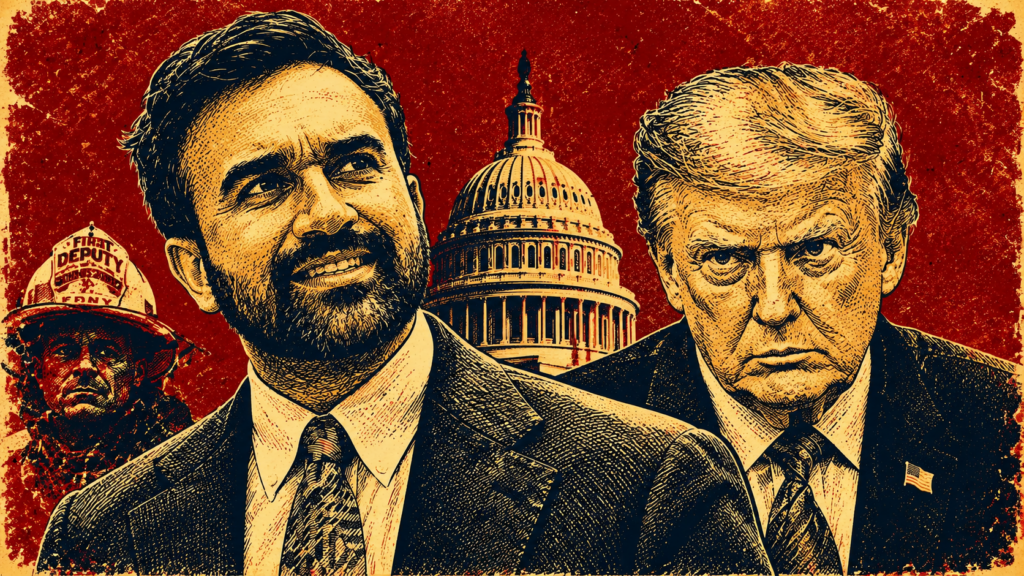
Mamdani Sues Trump Over New Immigration Rule
New York City Mayor Zohran Mamdani has joined a coalition of major U.S. cities in suing the Trump administration over a new immigration policy that could make it easier for federal officials to deny visas and green cards to immigrants based on their use of, or potential reliance on, government benefits. The lawsuit represents one of Mamdani’s most significant early legal confrontations with the Trump administration and places New York City at the center of a broader challenge to the federal government’s revived “public charge” policy.
The case was filed on September 14 in the U.S. District Court for the Southern District of New York. New York City is joined by other local governments, including Chicago, San Francisco, Seattle, Santa Clara County in California and King County in Washington. A separate lawsuit has been brought by New York Attorney General Letitia James and a coalition of 22 states and the District of Columbia. Together, the lawsuits seek to stop the Trump administration from implementing the new policy.
At the center of the dispute is a revised immigration rule issued by the Department of Homeland Security. The rule expands the circumstances under which immigration officials can determine that an applicant is likely to become a “public charge”—essentially someone who may depend on government assistance. Under the new approach, officials would have greater discretion to consider an immigrant’s use of public benefits when evaluating applications for immigration benefits, including green cards. The policy is scheduled to take effect on September 18.
The policy marks a return to an approach associated with President Donald Trump’s first administration. In 2019, the Trump administration introduced a broader public-charge rule that allowed immigration authorities to consider certain non-cash benefits, including programs such as Medicaid, food assistance and housing support. The policy faced extensive legal challenges and was subsequently reversed by the Biden administration in 2022. The Trump administration is now seeking to revive and broaden the approach.
The legal challenge argues that the new policy exceeds the authority granted to the Department of Homeland Security by Congress. The plaintiffs contend that the administration has adopted an interpretation of the public-charge standard that is inconsistent with longstanding immigration law and historical practice. They argue that DHS cannot simply expand the definition to encompass a broad range of benefits without sufficient statutory authority and proper legal procedures.
The cities are particularly concerned about the “chilling effect” the policy could have on immigrant families. Even people who are legally entitled to public assistance may become afraid to use those programs if they believe doing so could negatively affect their immigration status. That concern extends beyond immigrants themselves because many mixed-status households include U.S. citizens who are legally eligible for government programs.

Mamdani has argued that the policy could force immigrant families into an impossible choice between obtaining essential assistance and protecting their immigration prospects. His administration says the uncertainty created by the rule could discourage residents from accessing food, healthcare and housing assistance even when they are legally eligible to receive it. Bloomberg Law reported that Mamdani characterized the rule as intentionally vague and argued that it could create fear among immigrant New Yorkers.
Healthcare is one of the central concerns. Medicaid and other public-health programs could be affected if immigrants or families with immigrant members begin avoiding government assistance because of concerns about immigration consequences. The city coalition argues that reduced participation could ultimately create additional costs for local governments, hospitals and public-health systems.
The economic consequences could also extend beyond immigrant communities. State and local governments argue that widespread withdrawal from public-benefit programs could result in billions of dollars in lost federal funding and place additional financial pressure on local services. The state coalition has specifically warned about potential effects on Medicaid and the Children’s Health Insurance Program.
The new rule also differs from earlier public-charge policies in an important respect: it reportedly does not provide an equally narrow list of benefits that immigration officials can consider. Instead, the new framework gives officials broader discretion. Critics say that lack of specificity could produce inconsistent decisions and make it difficult for immigrants to know whether seeking assistance could jeopardize their immigration applications.
Another important issue is that benefits received by family members, including U.S.-citizen children, could potentially become relevant to an immigration assessment. That has generated particular concern among mixed-status families. A parent may be applying for immigration benefits while a U.S.-citizen child receives assistance to which the child is legally entitled.
The lawsuits therefore challenge not only the immigration consequences of the rule but also its administrative and legal foundation. The plaintiffs argue that DHS acted unlawfully and that the rule is arbitrary and contrary to congressional intent. The city lawsuit seeks a permanent injunction preventing the federal government from enforcing the policy. The states are separately asking the court to vacate the rule.
The Trump administration strongly disputes the plaintiffs’ characterization. DHS has defended the policy as a legitimate immigration-screening measure and has criticized Democratic-led jurisdictions opposing it. The administration’s broader position is that the federal government should have greater authority to determine whether prospective immigrants are likely to depend on taxpayer-funded benefits.
For Mamdani, the lawsuit also carries considerable political significance. His relationship with President Trump has already attracted national attention, and the immigration dispute puts the newly elected New York mayor directly against the federal administration on one of the most contentious issues in American politics. The lawsuit gives Mamdani an opportunity to position New York City as an institutional opponent of federal immigration policies that his administration considers harmful to immigrants and local residents.
Legally, however, the lawsuit is still at an early stage. No final ruling has been issued on whether the public-charge rule is lawful. The immediate objective of the plaintiffs is to prevent the rule from taking effect or to block its enforcement while the broader litigation proceeds. The court will have to consider the statutory authority of DHS, the Administrative Procedure Act and the government’s interpretation of federal immigration law.
The outcome could have national implications. If the cities and states succeed, implementation of the Trump administration’s expanded public-charge policy could be blocked nationwide or substantially limited. If the government prevails, immigration officials would gain broader discretion to consider public-benefit use when evaluating certain immigration applications.
The dispute also fits into a much larger pattern of legal battles between Democratic-led states and cities and the Trump administration over immigration. Since the administration returned to office, federal immigration policies have repeatedly been challenged in court over questions involving executive authority, immigration enforcement and the treatment of noncitizens.
For immigrant communities, the practical impact could be substantial even before a judge issues a final ruling. Fear and uncertainty can affect whether people seek medical care, enroll in food programs or access housing assistance. Critics of the rule argue that this deterrent effect is precisely what makes the policy particularly consequential.
For the Trump administration, the litigation is another test of its ability to implement a more restrictive immigration agenda while surviving challenges under federal administrative and immigration law.
The most accurate description of the development is therefore not that Mamdani has defeated the Trump administration, but that New York City and other local governments have launched a major legal challenge seeking to block a new federal immigration rule. The next important step will be whether the federal court grants preliminary relief before the policy’s scheduled September 18 effective date.

Key Legal Outcome
- New York City and several other local governments filed a federal lawsuit challenging the Trump administration’s revised public-charge immigration policy.
- The lawsuit seeks to prevent DHS from enforcing the expanded rule, which gives immigration officials broader discretion to consider public-benefit use when assessing certain immigration applications.
- The plaintiffs argue that DHS exceeded its statutory authority and that the rule conflicts with longstanding immigration law and legal precedent.
- The policy is scheduled to take effect September 18, 2026, giving the courts little time to consider requests for emergency relief.
- There is currently no final judicial ruling on the new rule; the lawsuit is at its initial stage and seeks declaratory and injunctive relief.
Why It Matters
- Immigration policy: The case could determine how broadly federal officials can consider an immigrant’s use of government benefits when evaluating visas and green cards.
- Healthcare access: Fear of immigration consequences could discourage eligible families from using Medicaid and other healthcare programs.
- Mixed-status families: U.S.-citizen children could be affected indirectly if their parents fear that using benefits for them could affect immigration applications.
- Federal-state conflict: The case tests how far the federal government can go when implementing immigration policy over objections from states and major cities.
- National precedent: A court ruling could influence similar challenges to the Trump administration’s broader immigration agenda across the country.
