
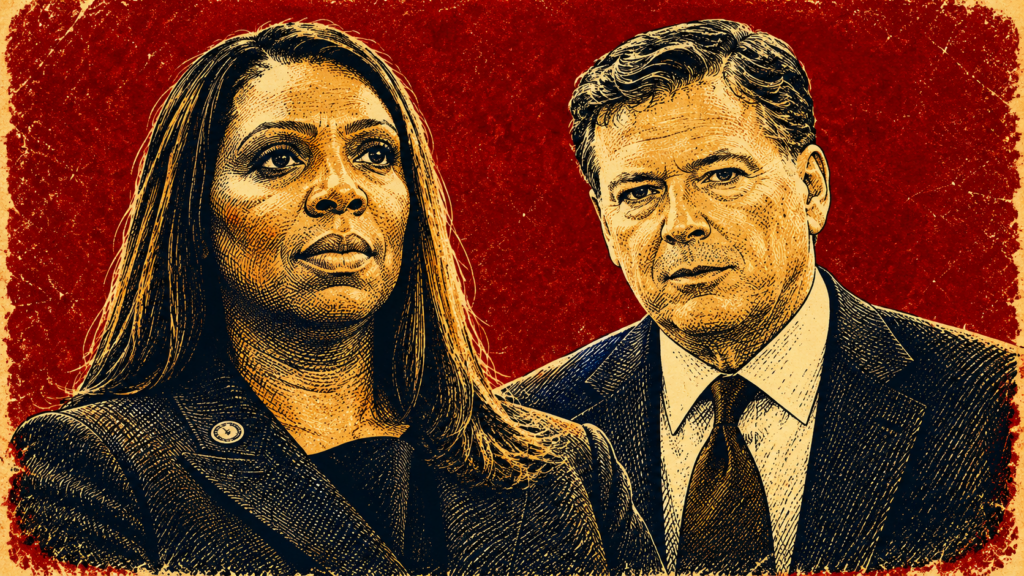
DOJ Seeks Revival of Comey, James Cases
The U.S. Department of Justice is asking a federal appeals court to revive criminal cases against former FBI Director James Comey and New York Attorney General Letitia James, putting two politically sensitive prosecutions back before a key judicial panel. The cases were previously dismissed after a federal judge found a fundamental problem with the appointment of the prosecutor who obtained the indictments. The Justice Department is now attempting to persuade the appeals court that the dismissals went too far and that the prosecutions should be allowed to continue.
The dispute is significant because it is not simply about the underlying criminal allegations against Comey and James. At the heart of the appeal is a constitutional and procedural question: whether the prosecutor who brought the cases had lawful authority to do so. The Justice Department’s effort to revive the cases therefore requires the appeals court to examine the lower court’s treatment of the prosecutor’s appointment and determine whether that defect justified throwing out the indictments.
Comey, the former FBI director, was indicted in 2025 on charges connected to his testimony before Congress. The prosecution accused him of making false statements and obstructing a congressional proceeding. The case arose from questions surrounding his testimony about the FBI’s investigation into Russian interference in the 2016 presidential election. Comey has denied wrongdoing and challenged the government’s allegations.
Letitia James, New York’s attorney general, faced a separate federal criminal case involving allegations related to mortgage fraud. She has denied wrongdoing. Her prosecution also became entangled with the appointment of the prosecutor responsible for obtaining the indictment.
The common thread between the two cases is Lindsey Halligan, who was appointed as interim U.S. attorney and subsequently secured the indictments. A federal judge later determined that Halligan’s appointment was unlawful. That ruling became the foundation for dismissing both prosecutions. The Justice Department has appealed those decisions, arguing that the cases should not have been terminated on that basis.
The Fourth Circuit is now being asked to address the issue. The appeals court is particularly important because its decision could determine whether prosecutors get another opportunity to pursue the charges or whether the lower-court dismissals remain in place. The outcome could also shape the Justice Department’s approach to cases in which prosecutors’ appointments or authority are challenged.
The procedural issue is crucial because federal criminal prosecutions depend on prosecutors having lawful authority to act on behalf of the United States. If an appointment is invalid, courts must determine what consequences should follow. One possible approach is to allow the government to correct the appointment and continue the prosecution. Another is to treat the defect as sufficiently serious to invalidate actions already taken by the improperly appointed prosecutor.

For the Justice Department, the stakes are therefore broader than simply winning two individual cases. The administration has publicly defended its decision to pursue the prosecutions, while critics have questioned whether the cases reflect the politicization of federal law enforcement. Reuters has reported that several high-profile prosecutions pursued by the Trump administration have encountered significant legal or procedural difficulties, including the cases involving Comey and James.
The Comey prosecution is particularly politically charged because of the former FBI director’s long-running conflict with President Donald Trump. Comey was dismissed as FBI director during Trump’s first presidency and subsequently became one of Trump’s most prominent critics. His prosecution has consequently attracted intense scrutiny over whether federal criminal law is being applied independently or being used against political opponents.
The James prosecution has generated similar concerns because Letitia James is a prominent Democratic elected official who had previously pursued major litigation against Trump and his business interests. Her indictment therefore became another test of whether the Justice Department could pursue politically prominent opponents without creating the appearance of retaliation.
The appeals court’s decision will not necessarily determine whether Comey or James is ultimately guilty or innocent. Instead, the immediate question is whether the criminal prosecutions can legally proceed following the lower court’s ruling concerning the prosecutor’s appointment. That distinction is essential when describing the case: the appeals court is being asked to address the viability of the prosecutions, not to decide the defendants’ ultimate guilt.
The case also illustrates the importance of the federal judiciary as a check on executive-branch authority. The Justice Department is part of the executive branch, but federal judges retain authority to determine whether prosecutors have acted within the law. An appellate ruling affirming the dismissals would reinforce the significance of statutory and constitutional limits on prosecutorial appointments. A reversal could give the government greater flexibility to cure appointment defects and continue cases.
The political implications could be equally significant. If the DOJ succeeds, prosecutors could receive another opportunity to pursue charges against two of Trump’s most prominent critics. If the appeals court rejects the government’s arguments, the administration would suffer another legal setback in cases that have already attracted national attention.
The dispute is also being watched because of what it says about institutional independence at the Justice Department. Federal prosecutors traditionally operate with substantial independence in deciding whom to charge and which cases to pursue. The Trump administration has taken a more aggressive approach toward cases involving individuals it believes acted improperly against Trump or his political interests. That has prompted debates over whether presidential control of the DOJ is being exercised within traditional legal norms.
At present, the most important fact is that the criminal cases remain subject to appellate review. The lower-court dismissals are not necessarily the final word. The DOJ’s appeal provides the government with a path to attempt to restore the prosecutions, while Comey and James continue to challenge the legal foundation of the cases.
Ultimately, the appeals court’s ruling could have consequences extending well beyond these two defendants. It may clarify how courts should handle criminal cases brought by prosecutors whose appointments are later found unlawful, and it could influence future disputes involving interim U.S. attorneys and executive-branch appointments.
For news coverage, the strongest angle is therefore not simply that the DOJ is “bringing back” the cases. The more precise description is that the Justice Department is asking a federal appeals court to overturn the dismissals and allow the prosecutions of Comey and James to proceed. The outcome will determine whether these politically consequential cases receive another chance in federal court.

Key Legal Outcome
- The Justice Department is appealing the dismissal of the criminal cases against James Comey and Letitia James.
- The dismissals centered on the legality of prosecutor Lindsey Halligan’s appointment as interim U.S. attorney.
- The DOJ wants the appeals court to revive the prosecutions, rather than allowing the lower-court dismissals to stand.
- The appeals court is not deciding Comey or James’s ultimate guilt or innocence at this stage; it is addressing whether the prosecutions can legally proceed.
- The cases remain unresolved pending appellate action, making the appeals court’s decision the next major legal milestone.
Why It Matters
- Tests DOJ independence: The cases raise questions about the relationship between presidential control and prosecutorial independence.
- Could affect politically sensitive prosecutions: A DOJ victory would allow the government to continue pursuing two prominent Trump critics.
- Important appointment precedent: The ruling could clarify what happens when a prosecutor’s appointment is later found unlawful.
- Broader constitutional implications: The dispute involves limits on executive authority and the legal powers of federal prosecutors.
- Political stakes are high: Comey and James are both prominent Trump adversaries, making the cases closely watched as tests of whether federal criminal law is being applied impartially.
